
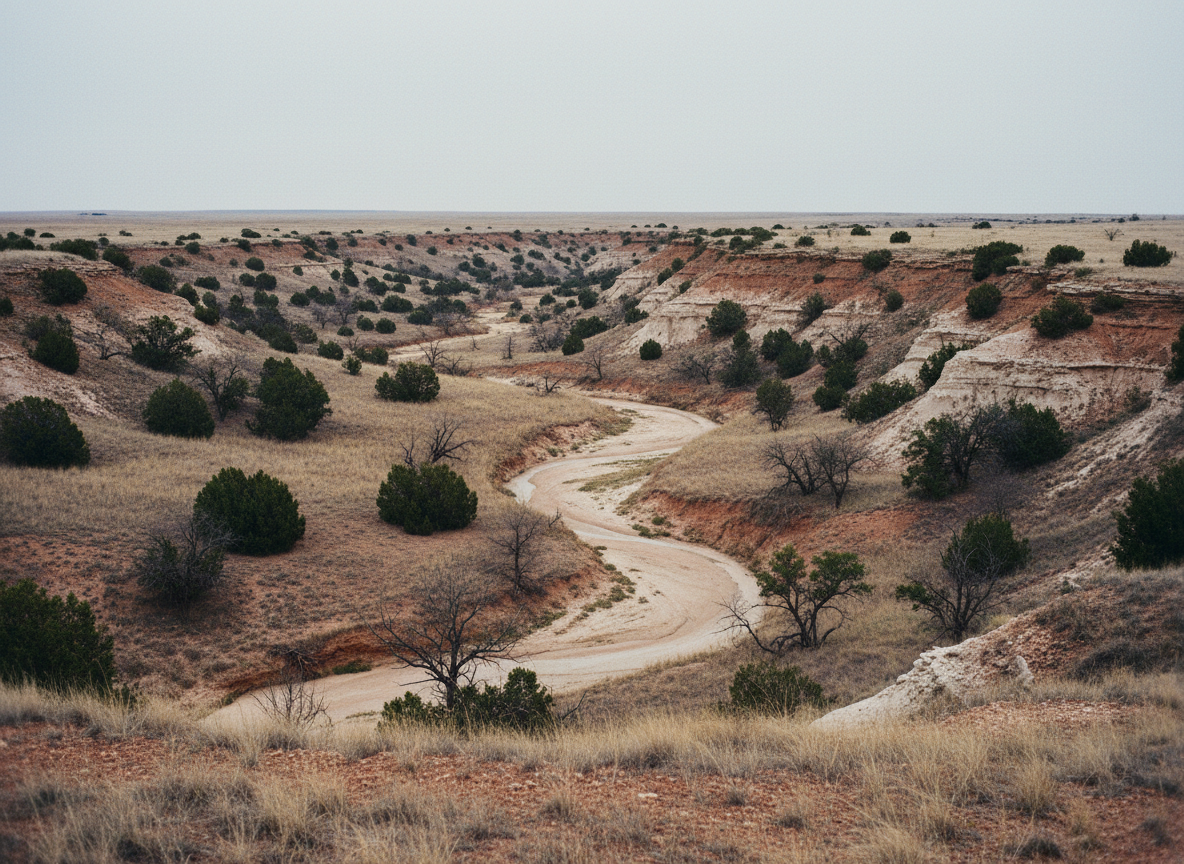
Wind and thermals are why a hunter can do everything else right in canyon country and still get blown out of a draw at first light. The forecast said south at twelve. The flag on your stand says south at twelve. And the doe feeding two hundred feet below you throws her head up, stares at your tree, and leaves — because the air on that slope is not doing what the air above it is doing. In the Caprock breaks the terrain writes its own weather, and hunters who learn to read it kill deer in places that look unhuntable on a map.
Wind and Thermals Are Two Different Problems
Wind is what the weather is doing. Thermals are what the ground is doing. They run on separate schedules and they are frequently in disagreement.
Thermals are simple physics. Air warms, air rises; air cools, air sinks. When the sun comes over the rim and heats a canyon slope, the air against that slope climbs and carries your scent up with it. When the sun comes off in the evening and the rock gives up its heat, that air turns heavy and pours down the drainage like water. Every canyon, side draw and finger of a wash does this daily, whether or not any wind is blowing.
In a wheat field on top of the Caprock thermals barely matter — flat ground produces almost none and the prevailing wind owns the field. Drop forty feet off the rim into a draw and the ranking flips.
The Daily Thermal Cycle in the Breaks
The cycle is predictable enough to hunt by, in four parts.
Before daylight, thermals run downhill. The ground has shed heat all night and the cold air has settled into the bottoms. Walk into a draw at four-thirty and everything you smell like goes down the drainage ahead of you, straight into the deer you are trying to reach. It is the most common way hunters ruin a morning out here, and almost nobody accounts for it.
Thirty to sixty minutes after sunrise, they flip. There is a slack period of a few minutes where the air does not know what it wants, then the slope heats and everything reverses and climbs. East-facing slopes flip earlier; a north-facing slope in a deep canyon may not flip until mid-morning, or at all in late season.
All day, thermals run uphill — strongest mid-afternoon on a sunny slope. If you are above a bedded deer at midday, your scent is going to him.
Starting an hour or so before sunset, they flip back down. This is the one that matters most to a bowhunter, because it coincides exactly with the evening movement you were waiting for. A stand that played perfectly at two in the afternoon can be unhuntable at six.
Once you can read wind and thermals together, there is a practical shortcut: hunt uphill of deer in the morning, downhill of deer in the evening. The thermal is carrying your scent away from them in both cases.
The Prevailing Wind on Top of the Caprock
The Panhandle’s default is a south or southwest wind, rarely gentle. Fifteen to twenty-five miles an hour in October is an ordinary day, which has one advantage — a steady hard wind overpowers the thermals and gives you one direction to plan around.
The exception is the front. When one comes through, the wind swings hard north and climbs, and for a day or two every stand on the place is wrong. Deer move well on a front, and the hunters who already have a north-wind setup picked out are the ones who can use it. Most people own only south-wind stands and sit them anyway.
Knowing the synoptic wind a day out is the easy part. The National Weather Service office in Amarillo posts hourly speed and direction for Amarillo, Dalhart, Borger, Dumas, Perryton and a string of other Panhandle stations, and a front that swings the wind north is visible well before it arrives. Check it the night before and pick the stand to match. What no forecast tells you is what the air does once it drops off the rim.
Terrain bends wind too. A hard south wind crossing a canyon rim spills over the edge and rolls, and the pocket just below the rim on the downwind side can be dead calm or blowing back uphill. That eddy is why deer bed under a rim on a windy day, and why a stand sited on the rim itself almost never works.
When Wind and Thermals Disagree
Here is the part that costs people deer. When wind and thermals disagree, the air does something that matches neither one.
Sort it by strength. Wind over about fifteen miles an hour wins nearly everywhere, even in a deep canyon. Under five, thermals win outright. Between five and fifteen it swirls, and nobody can reliably predict it — you have to check.
A pocket wind checker settles the argument in a second, and it is the cheapest useful thing in a bow pack. Hunter’s Specialties Windicator is unscented talc in a squeeze bottle — one puff and you watch where it goes instead of guessing from what your cheek feels. The important habit is checking it every time the terrain changes shape, not just once when you sit down. A hundred yards along a bench can be a different answer.
Milkweed floaters do the same job better at distance — they hang and drift a hundred yards and show the whole current rather than the first three feet of it, and you can pick them off fence lines in the fall for nothing. A Kestrel pocket weather meter gives you an exact speed if you want the number, but it reads only the air where you stand and says nothing about the slope below you; the talc is more useful for less money, and Kestrels are generally a dealer or direct-order item anyway.
Siting a Stand You Can Hunt Twice
The mistake is picking the spot with the best sign and hoping the wind cooperates. Reverse it. Find the travel route first, then the one approach and setup the air allows, and accept that you can hunt it only on certain days.
Three things make a canyon setup repeatable. Your scent cone has to spill into dead country — open pasture, a plowed field, the far side of a rim where deer are not traveling. Your access route has to be clean in the direction the thermal is running at the hour you walk in, which usually means a ridge top in the dark rather than a draw bottom. And you want a mirror setup across the drainage for when the front comes.
Two stands on one funnel, hunted correctly, will outproduce six hunted whenever the mood strikes. Twenty-seven years of guiding hunters through this country made that lesson monotonous: the deer were almost never the problem, the approach was.
Binoculars let you work this out without walking through it. An opposite rim at gray light tells you in one morning what three weeks of boot leather guesses at. A mid-priced 10×42 like the Vortex Diamondback HD is plenty of glass for canyon distances and holds up to being dragged across caliche, which matters more out here than the last few percent of edge sharpness.
Stalking With the Thermal Instead of Against It
Spot-and-stalk is genuinely on the table in the breaks, and the thermal cycle decides the route.
If you glass a buck bedding on a slope in the morning, do not go straight at him — the mid-morning thermal is climbing that slope and he sits above the only line you would take. Come at him from the side along a bench, or leave him and return in the evening once the air has turned over and you can work down from the top.
Watch the slack window. In the twenty or thirty minutes a thermal spends changing direction, a slope is as close to scent-neutral as it gets, and that is when a stalk is worth attempting on a deer you otherwise could not reach.
When You Cannot Win the Wind
Sometimes the only huntable setup puts your scent where you do not want it. Scent control helps at the margin — a Scent Killer Gold kit covers washing gear and spraying down, and clothes stored outside the house are worth the trouble. None of it beats a deer’s nose, though, and anyone who says otherwise is selling something.
The better answer is the harder one: do not hunt it. A funnel burned on a bad wind in the first week of October will not produce again until the rut, and sometimes not then. Sit a second-choice spot with clean air, scout a different section, or stay home. A canyon holds your scent in a way open country does not.
Learn One Drainage
Pick one canyon and spend a few evenings in it with a bottle of talc and no bow. Puff it at the rim, halfway down, in the bottom, at the head of a side draw, and watch what the air does as the sun comes off the slope. It will not match the forecast and it will not match what you expected — and after three or four evenings you will know how wind and thermals behave in that drainage well enough to hunt it on purpose instead of on hope.
The terrain reading that goes with this — finding the saddles, benches and draw heads deer actually travel — is covered in archery whitetail tactics for Caprock canyon country, and the pre-season groundwork is in how to pattern a Panhandle whitetail. More on the animals is on the whitetail deer and mule deer guides, and the kit worth carrying is on the Recommended Gear page.
Leave a Reply