As an affiliate, we earn a commission from qualifying purchases made through links on this site.

Category: Mule Deer

  • How to Field Dress a Whitetail Deer: Step-by-Step

    How to Field Dress a Whitetail Deer: Step-by-Step

    Early archery season on the Panhandle means one thing a lot of new hunters don’t plan for: heat. A deer down at 7pm in September can spoil fast if the meat doesn’t start cooling within the hour, and that clock starts the second the arrow hits, not when you get around to it. Field dressing isn’t the hard part of deer hunting — it’s just a part nobody explains clearly the first time. Here’s how to field dress a deer, start to finish.

    The gear you need to field dress a deer: a fixed-blade hunting knife, gloves, and a game bag laid out on a truck tailgate.
    The basics worth having in the truck before opening morning: a sharp fixed-blade knife, a pair of gloves, and game bags.

    Before You Make a Cut

    Get gloves on before you touch anything — field dressing is where hunters most often end up with a cut or a case of something they didn’t need to catch. Tag the deer per Texas Parks and Wildlife requirements first. Then roll the deer onto its back and, if you’ve got help, prop the hindquarters up slightly with a rock or a pack; gravity does some of the work for you once the cavity opens.

    You need a sharp knife — a guthook on the blade is worth having for this specific job, since it lets you open the skin without driving the point in deep. A CRKT Soldotna is a solid, purpose-built choice: a shorter blade you can control precisely instead of a long fixed blade that’s easy to plunge too deep.

    Opening the Cavity

    1. On a buck, remove the testicles first. On a doe, your starting point is just forward of the udder.
    2. Pinch the skin and make a small entry cut, then turn your blade edge-up and run it toward the sternum, guiding with two fingers ahead of the blade so you’re cutting skin and thin muscle only. Go shallow. A deep cut here punctures the stomach or intestines and turns a clean job into a genuinely unpleasant one.
    3. Widen the opening enough to work both hands into the cavity.

    Clearing the Cavity

    1. Reach in and pull the stomach and intestines down and out of the lower cavity, keeping the large intestine intact as you go — a puncture here is what actually ruins meat, more than anything else in this process.
    2. Find the diaphragm, the thin sheet of muscle separating the chest cavity from the lower cavity, and cut it free along the inside of the ribs on both sides.
    3. Reach up into the chest cavity, sever the esophagus and windpipe as high as you can reach, and pull the heart and lungs out as one unit.

    Finishing the Job

    1. Split the pelvis if you want the bladder and remaining lower intestine out cleanly — a small saw or a good pair of shears makes this a ten-second job instead of a fight with a knife blade.
    2. Carefully cut around and remove the bladder, keeping it upright so it doesn’t spill on the meat.
    3. Roll the deer to drain remaining blood, and wipe the cavity out with a clean cloth or dry grass rather than water if you’re not near clean water — you want the cavity dry, not rinsed with anything questionable.

    Getting Ahead of Panhandle Heat

    This is the step that matters more here than in cooler country. Once the cavity is open and cleared, prop it open with a stick to let air move through, and get the deer into shade if there’s any to be had — a cedar draw or a north-facing cut works if you can drag or quarter the deer to reach one. If temperatures are still in the 70s or 80s, which is common during the Panhandle archery opener, don’t wait on a full retrieval with a truck. Quartering the deer in the field and getting the meat into game bags and a cooler beats leaving a whole carcass hanging in the heat while you figure out logistics.

    What Comes Next

    Field dressing only buys the meat time — it doesn’t finish the job. Get the deer skinned and into a cooler or a walk-in as soon as you reasonably can, and don’t let a good shot on a good buck go to waste over a few hours of avoidable heat. The steps from here — skinning, quartering, and aging — are worth learning properly too, and we’ll cover the full breakdown in the next Field Processing post.

    How to Field Dress a Deer: Shopping Guide

    If your kit isn’t built out yet, here’s everything covered above in one place — the gear worth having in the truck before you need it, not after.

    • Glovesshoulder-length nitrile gloves keep blood and bacteria off your hands, and off any small cut you don’t know you have yet.
    • Knife — a CRKT Soldotna or something similar with a guthook handles the cuts described above without much risk of going too deep.
    • Saw or shears — a dedicated pair of hunting shears splits the pelvis in seconds instead of turning it into a fight with a knife blade.
    • Game bagsbreathable game bags keep quartered meat clean and let it cool, instead of trapping heat against cooler plastic.
    • Cooler — something built to actually hold ice, like an RTIC 52 QT hard cooler, is what gets quartered meat through a hot Panhandle afternoon.
    • Rags or wipesheavy-duty hand and tool wipes clean up hands, knife, and gear without needing water you can’t vouch for.
    • Headlamp — a lot of field dressing happens before sunrise or after dark. A rechargeable headlamp keeps both hands free when you need them most.
  • Best Rangefinders for West Texas Whitetail and Mule Deer

    Best Rangefinders for West Texas Whitetail and Mule Deer

    West Texas doesn’t do anything halfway, and that includes the distances. A shot that looks like 200 yards across a wheat field can run past 300 once you actually range it, and guessing wrong in Palo Duro Canyon costs more hunters their tag than bad shooting ever does. A good rangefinder isn’t optional gear out here — it’s the difference between a clean shot and a long walk home with nothing to show for it. Here’s what actually holds up in Panhandle conditions, and what to look for if you’re buying your first one. Whether you’re after whitetail in the wheat or picking the best rangefinder for mule deer across open canyon country, the same core features matter.

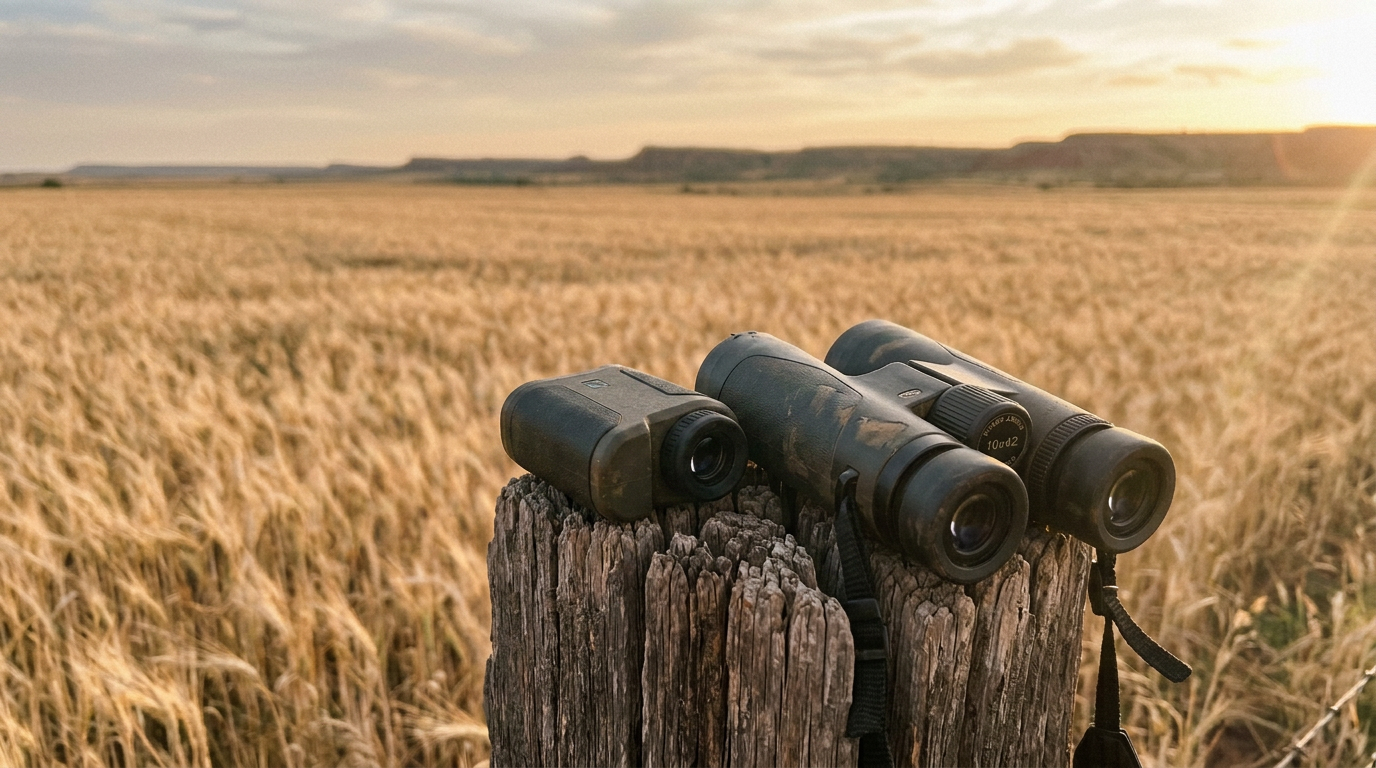
    A compact laser rangefinder and a pair of binoculars resting on a weathered fence post at the edge of a West Texas wheat field at golden hour.
    Rangefinder and binoculars staged on a fence post at the edge of a wheat field — the kind of glassing setup that matters most on long West Texas shots.

    What Actually Matters Out Here

    Most rangefinder marketing leans on max range, and that number is close to useless on its own. A unit that claims 2,000 yards on a reflective road sign might only read a deer-sized target at 600. What matters for whitetail and mule deer hunting on this ground is the deer-specific range, angle compensation, and how fast the unit reads in real conditions — wind moving the brush, low morning light, gloved hands.

    Angle compensation is the one you can’t skip. Canyon rims, cedar breaks, and the folds along the Canadian River put you shooting up or down more often than level, and a steep angle shrinks the actual distance the bullet has to travel. A rangefinder that gives you true horizontal distance does that math for you instantly. One that doesn’t leaves you holding over a target you’ve already overestimated.

    Best Overall: Leupold RX-5000 TBR/W

    The Leupold RX-5000 TBR/W reads to 5,000 yards on reflective targets and comfortably out past the ranges most Panhandle shots actually happen at, with Leupold’s True Ballistic Range/Wind system doing the angle and wind-hold math for you. It’s the same TBR/W technology that’s been the standard pick on our full gear list for years, updated with a longer read distance and a cleaner display. Simple two-button operation, and it still works with a glove on, which matters more than people think once that first cold front rolls through in November.

    Best Budget: Leupold RX-1400i TBR/W Gen 2

    If this is your first rangefinder, or you’re outfitting a kid for a youth hunt, the Leupold RX-1400i TBR/W Gen 2 covers real deer-hunting distance — around 950 yards on a deer-sized target — with the same angle-compensating TBR/W math as the more expensive units. Most whitetail shots on this ground run 150 to 300 yards anyway. This unit ranges well past that without paying for capability you won’t use.

    Best Rangefinder for Mule Deer: Vortex Razor HD 4000 GB

    Mule deer hunting on the canyon rims and wind-scoured mesas is a different game than sitting a whitetail draw, and it’s where the best rangefinder for mule deer country earns its keep. You’re often ranging a buck the moment you spot him, across a canyon, before he ever knows you’re there. The Vortex Razor HD 4000 GB reads out to roughly 2,200 yards on a deer-sized target and runs Vortex’s ballistics solver, which is the extra headroom that big, open canyon country calls for. It’s also simply the best glass of the three — worth it if you spend more time glassing than shooting.

    Whitetail vs. Mule Deer: Different Ranging Problems

    A whitetail hunter posted up in a finger draw off the wheat is usually ranging known landmarks ahead of time — that fence post, that cedar, that break in the CRP — so the shot is already anticipated before a deer shows up. A mule deer hunter glassing canyon rims is doing the opposite: spotting a buck first, then ranging him cold, often at a steeper angle and a longer distance than a whitetail hunter ever deals with. If you hunt both, buy for the mule deer distances. It’s easy to range a close whitetail with a long-range unit; it’s impossible to range a far mule deer with a short one.

    Before the Season Starts

    Range known distances around your stand or blind before opening day, not during the moment of truth. Walk off or map the yardage to the fence post, the tank dam, the edge of the milo, then check your rangefinder against it. That five minutes of homework is what turns a rangefinder from a number on a screen into a number you trust when a good buck steps out and your hands aren’t quite steady. Check the full Recommended Gear list for the rest of the optics kit that pairs with it.