
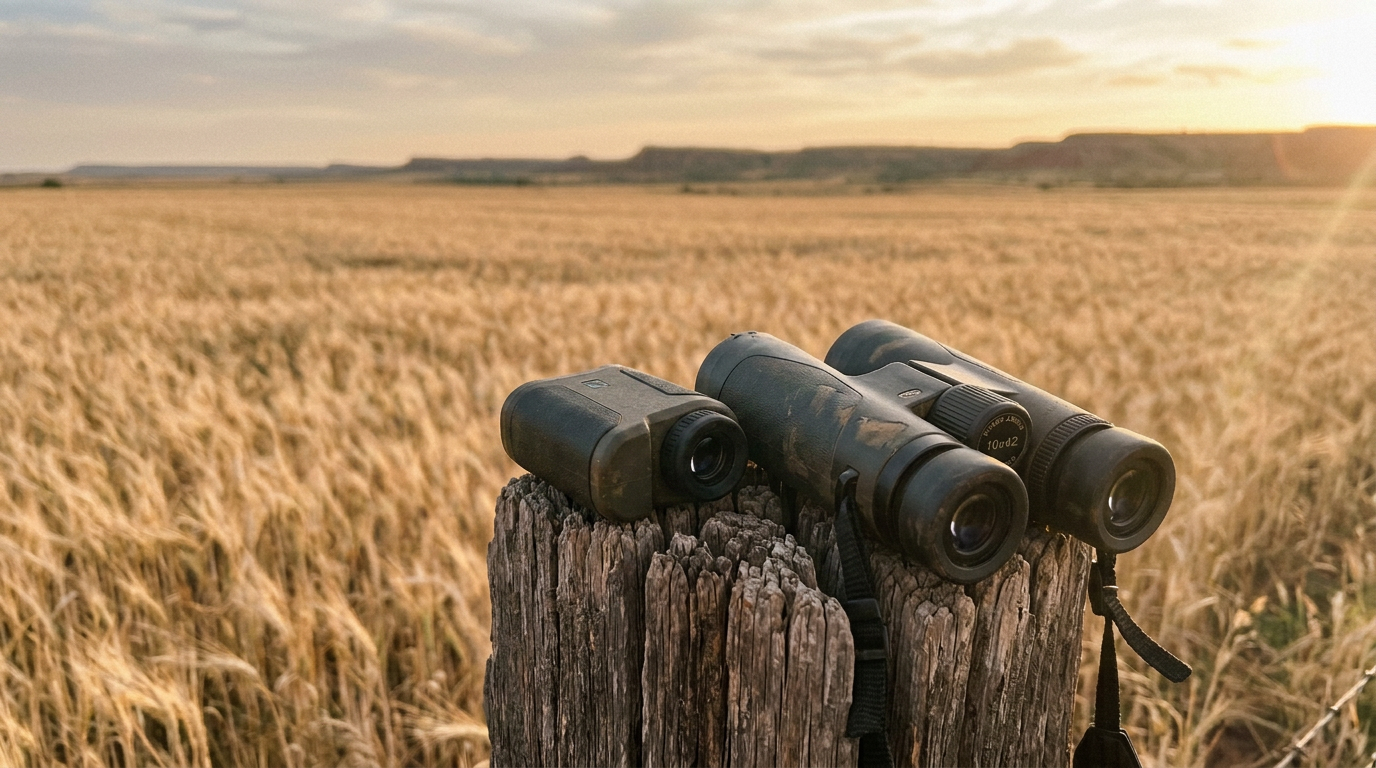
West Texas doesn’t do anything halfway, and that includes the distances. A shot that looks like 200 yards across a wheat field can run past 300 once you actually range it, and guessing wrong in Palo Duro Canyon costs more hunters their tag than bad shooting ever does. A good rangefinder isn’t optional gear out here — it’s the difference between a clean shot and a long walk home with nothing to show for it. Here’s what actually holds up in Panhandle conditions, and what to look for if you’re buying your first one. Whether you’re after whitetail in the wheat or picking the best rangefinder for mule deer across open canyon country, the same core features matter.

What Actually Matters Out Here
Most rangefinder marketing leans on max range, and that number is close to useless on its own. A unit that claims 2,000 yards on a reflective road sign might only read a deer-sized target at 600. What matters for whitetail and mule deer hunting on this ground is the deer-specific range, angle compensation, and how fast the unit reads in real conditions — wind moving the brush, low morning light, gloved hands.
Angle compensation is the one you can’t skip. Canyon rims, cedar breaks, and the folds along the Canadian River put you shooting up or down more often than level, and a steep angle shrinks the actual distance the bullet has to travel. A rangefinder that gives you true horizontal distance does that math for you instantly. One that doesn’t leaves you holding over a target you’ve already overestimated.
Best Overall: Leupold RX-5000 TBR/W
The Leupold RX-5000 TBR/W reads to 5,000 yards on reflective targets and comfortably out past the ranges most Panhandle shots actually happen at, with Leupold’s True Ballistic Range/Wind system doing the angle and wind-hold math for you. It’s the same TBR/W technology that’s been the standard pick on our full gear list for years, updated with a longer read distance and a cleaner display. Simple two-button operation, and it still works with a glove on, which matters more than people think once that first cold front rolls through in November.
Best Budget: Leupold RX-1400i TBR/W Gen 2
If this is your first rangefinder, or you’re outfitting a kid for a youth hunt, the Leupold RX-1400i TBR/W Gen 2 covers real deer-hunting distance — around 950 yards on a deer-sized target — with the same angle-compensating TBR/W math as the more expensive units. Most whitetail shots on this ground run 150 to 300 yards anyway. This unit ranges well past that without paying for capability you won’t use.
Best Rangefinder for Mule Deer: Vortex Razor HD 4000 GB
Mule deer hunting on the canyon rims and wind-scoured mesas is a different game than sitting a whitetail draw, and it’s where the best rangefinder for mule deer country earns its keep. You’re often ranging a buck the moment you spot him, across a canyon, before he ever knows you’re there. The Vortex Razor HD 4000 GB reads out to roughly 2,200 yards on a deer-sized target and runs Vortex’s ballistics solver, which is the extra headroom that big, open canyon country calls for. It’s also simply the best glass of the three — worth it if you spend more time glassing than shooting.
Whitetail vs. Mule Deer: Different Ranging Problems
A whitetail hunter posted up in a finger draw off the wheat is usually ranging known landmarks ahead of time — that fence post, that cedar, that break in the CRP — so the shot is already anticipated before a deer shows up. A mule deer hunter glassing canyon rims is doing the opposite: spotting a buck first, then ranging him cold, often at a steeper angle and a longer distance than a whitetail hunter ever deals with. If you hunt both, buy for the mule deer distances. It’s easy to range a close whitetail with a long-range unit; it’s impossible to range a far mule deer with a short one.
Before the Season Starts
Range known distances around your stand or blind before opening day, not during the moment of truth. Walk off or map the yardage to the fence post, the tank dam, the edge of the milo, then check your rangefinder against it. That five minutes of homework is what turns a rangefinder from a number on a screen into a number you trust when a good buck steps out and your hands aren’t quite steady. Check the full Recommended Gear list for the rest of the optics kit that pairs with it.
Leave a Reply