
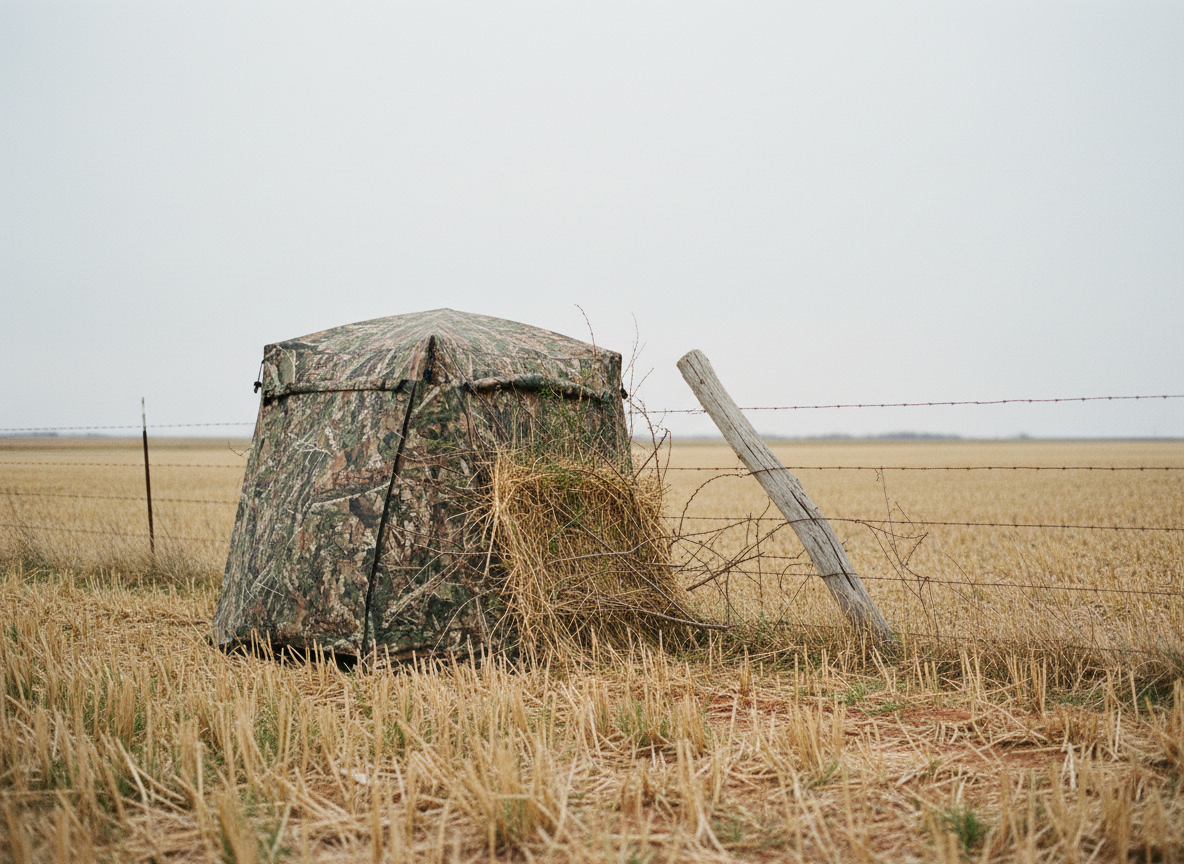
A blind that disappears in an East Texas thicket sits out on the Panhandle plains like a parked car. That’s the whole problem with choosing ground blinds for open country — there’s no backdrop to break up the outline, the wind never quits, and deer out here see a long way because they’ve always had to. Most blind advice is written for timber. Here’s what actually matters when the nearest cover is a fence line and a quarter section of milo stubble.
Why Open Country Breaks Most Blind Advice
Three things are different here, and each one changes what you should buy.
There’s nothing behind you. In timber, a blind sits against a wall of trunks and brush and vanishes. On a wheat field edge, a blind is a dark box against open sky. Camo pattern barely matters at that point — what matters is height, shape, and whether you’ve done anything to tie it into something.
The wind is a structural problem, not a comfort problem. Sustained twenty to thirty is an ordinary day out here, and spring and late fall will hand you gusts well past that. A hub blind that isn’t anchored properly does not flap — it leaves. People lose blinds every year, and the ones that don’t blow away still rattle and pop all morning, which is its own kind of failure.
Deer see you from distances that don’t apply in the woods. A whitetail crossing a plowed section can look at your setup from four hundred yards and decide about it before he ever gets in range. That means a blind has to be in place long enough to become furniture, and it means you need to see him coming without opening a window.
What to Look for in Ground Blinds for Open Country
Low profile beats roomy. Height is what gets a blind noticed on flat ground. A blind you can sit up straight in with a foot of headroom to spare is a blind that stands a foot taller than it needs to. Manufacturers sell interior height as a feature because it’s easy to advertise. Out here it’s a liability.
See-through walls are worth more here than anywhere else. The technology that lets you look out through the fabric from inside while the outside stays opaque solves the specific open-country problem of watching a deer come across a half mile of nothing. You track him the whole way without cracking a window, which is exactly the movement that gets you caught on a bright, still morning.
Count the real stake points. Not the little fabric tabs — look for reinforced loops at every corner and mid-panel, plus tie-off points up high for guy lines. This is the spec that separates a blind that survives three seasons out here from one that doesn’t survive one.
A dark interior matters more than the outside camo. Black interior coating kills the silhouette of a hunter moving inside. On a sunny afternoon with the sun behind the blind, a light interior turns you into a shadow puppet.
Judge fabric by weight, not by the word “silent.” Heavier fabric is quieter in wind, holds its shape, and lasts against UV. Panhandle sun destroys thin blind fabric in two or three seasons regardless of what the tag says.
Blinds Worth Considering
The Rhino Blinds R180 is the one that fits this country best, and the reason is the see-through walls. From inside you get roughly 180 degrees of view straight through the fabric — the entire front of the blind — while the outside stays opaque. On a wheat field or a CRP edge where you can see for a long way, that’s not a gimmick. It’s the difference between tracking a deer the whole way across open ground and getting surprised at thirty yards with a bow in your lap. It’s sized for three, which in practice means two adults with room to draw. The trade is bulk and weight: this is a blind you set in one spot for the season, not one you pack around.
Primos pioneered this idea with the Double Bull SurroundView line, and their 360-degree version is still the most complete execution of it — see-through on all four walls instead of just the front. Amazon stock on those comes and goes; they’re carried steadily by Bass Pro, Cabela’s, and Primos direct, and worth pricing against the Rhino if you want the full wrap-around view.
For a blind you actually carry, the Ameristep Caretaker Kick Out goes the other direction and does it well. It’s a one- or two-person hub blind with a genuinely low profile, it packs small, and it costs a fraction of the see-through blinds. The low silhouette is the point — tucked into a fence corner or a terrace with brush piled against it, it’s hard to pick out. Two people in it with a bow is tight, and that’s the honest trade for the size and price.
If you’re setting up permanently on ground you control, insulated fiberglass box blinds — Redneck Blinds is the name most people know — are a different category of product entirely. Weatherproof, genuinely quiet, and they last twenty years. They sell direct and through dealers rather than Amazon, and they’re worth pricing out if you’re putting something on a place you own rather than hauling a blind in and out.
Anchoring It Against Panhandle Wind
This is where most open-country blind setups fail, and the stakes that came in the bag are why. Those six-inch wire pins are meant for lawn use. In sandy Panhandle soil they pull out in a twenty-mile-an-hour gust, and in hard caliche they bend before they seat.
A proper anchor kit fixes it. A blind stake kit with ratchet tie-downs gives you heavy metal stakes plus straps to run from the upper tie-off points down to ground anchors, which is the part that actually keeps a blind from lifting. Cheap insurance against replacing a blind.
Three more things worth doing. Drive a T-post at the two windward corners and strap the blind frame to them. Put weight inside on the floor — a couple of sandbags or a five-gallon bucket of dirt does more than people expect. And site the blind where terrain is already helping: the lee side of a terrace, a fence corner with a cedar in it, the down-wind side of an old windmill or a round bale. A blind in a hollow outlasts a blind on a rise every time.
Brush It In, and Set It Early
A blind set two weeks before you hunt it is a different blind than one set that morning. Deer in open country pay close attention to new objects and then stop caring once nothing bad happens around them. Two to three weeks is the number worth aiming for.
Brushing in is not decoration. Pile cut mesquite, sunflower stalks, kochia, whatever grows on that ground, against the windward and field-facing sides until the blind’s straight edges are broken up. The goal isn’t to hide the blind — you can’t, out there — it’s to make the shape stop reading as a box. Cut brush from somewhere else on the property, not from the fifty yards around your setup, or you’ll open up the very cover that made the spot good.
When a Treestand Still Wins
Open country doesn’t mean treeless. The creek bottoms, the cottonwood lines along the draws, and the shelterbelts planted around old homesteads all hold trees big enough to hunt, and those are exactly the corridors deer use to cross open ground.
For a stand you’ll sit all day in cold weather, the Millennium M100U Ultralite is the one people stop complaining about. The sling seat is the reason — it’s comfortable enough that you stay put through the midday hours when a pressured Panhandle buck is actually moving.
If you’d rather move than commit, the Hawk Helium Kickback XL is light enough to pack in and hang the same morning, which suits hunting a cottonwood line where the right tree depends on which way the wind is blowing that day. Pair it with a set of aluminum climbing sticks rather than fighting a cottonwood’s bark with a climber.
A harness is not optional and not a place to save money. The Muddy Magnum Elite is the straightforward pick — padded, quick-release buckles, and comfortable enough that people actually wear it, which is the only spec that matters. Hunter Safety System builds the harnesses most hunters know by name and they’re worth a look too, but their Amazon listings come and go by size, so buy those direct or through a dealer rather than hunting for a live listing.
Whichever harness you buy, run a lifeline from the ground to above your stand and stay clipped to it the whole way up and down. This is the part people skip. Nearly every treestand fall happens to somebody who owned a harness and wasn’t attached to anything yet — on the sticks, or stepping across onto the platform. The harness only works if you’re tied to the tree while you’re climbing, not just once you sit down.
Saddle hunting deserves a mention because it solves the crooked-cottonwood problem better than any stand does. Tethrd and Lone Wolf Custom Gear are the two names worth researching, and both sell direct rather than through Amazon. If you hunt scattered trees and move often, it’s the system to look at.
Tripods: The Honest Answer for Flat Ground
Where there’s genuinely no tree — the middle of a section, a playa edge, a milo field with sunflowers grown up over your head — a tripod does what neither a blind nor a stand can. Ten or twelve feet of elevation gets your sightlines above standing crop and puts your scent stream above a deer’s nose on flat ground.
The Muddy Horizon Tripod covers the usual version of this: a swivel seat, a shooting rail, and a footprint you can move with two people and a truck. Brush the legs and wrap the base in burlap or camo netting, because an unwrapped tripod with a hunter sitting in the open on it is the most visible thing in that field.
The honest limitation: a tripod in thirty-mile-an-hour wind is a bad place to be. It moves, it’s cold, and there’s nothing between you and it. On the windiest days a staked-down ground blind is the better tool, which is a real argument for owning both.
The Small Things That Decide Whether You Sit Still
A blind fails on comfort more often than on concealment. Four hours in a folding camp chair that creaks every time you shift and you’ll start moving, and movement is what deer catch.
A proper silent swivel blind chair is the single upgrade most blind hunters notice immediately. Being able to turn toward a window without picking a chair up off the ground is worth more than another layer of camo.
Two more cheap fixes. Put a piece of old carpet or a rubber mat on the floor so boots on dirt and gravel stop making noise. And wear dark clothing inside a blind, not camo — camo breaks up against brush, but inside a dark box, black is what makes you disappear in the window openings.
If You Only Buy One
For most people hunting open Panhandle ground, a low-profile hub blind plus a real anchor kit, set three weeks early and brushed in properly, will kill more deer than a better blind set the morning of. The setup matters more than the product. Get it in the ground, leave it alone, and let the deer stop noticing it. More on the species and the country is on the whitetail deer and mule deer guides, and the rest of what we recommend is on the Recommended Gear page.
Leave a Reply