
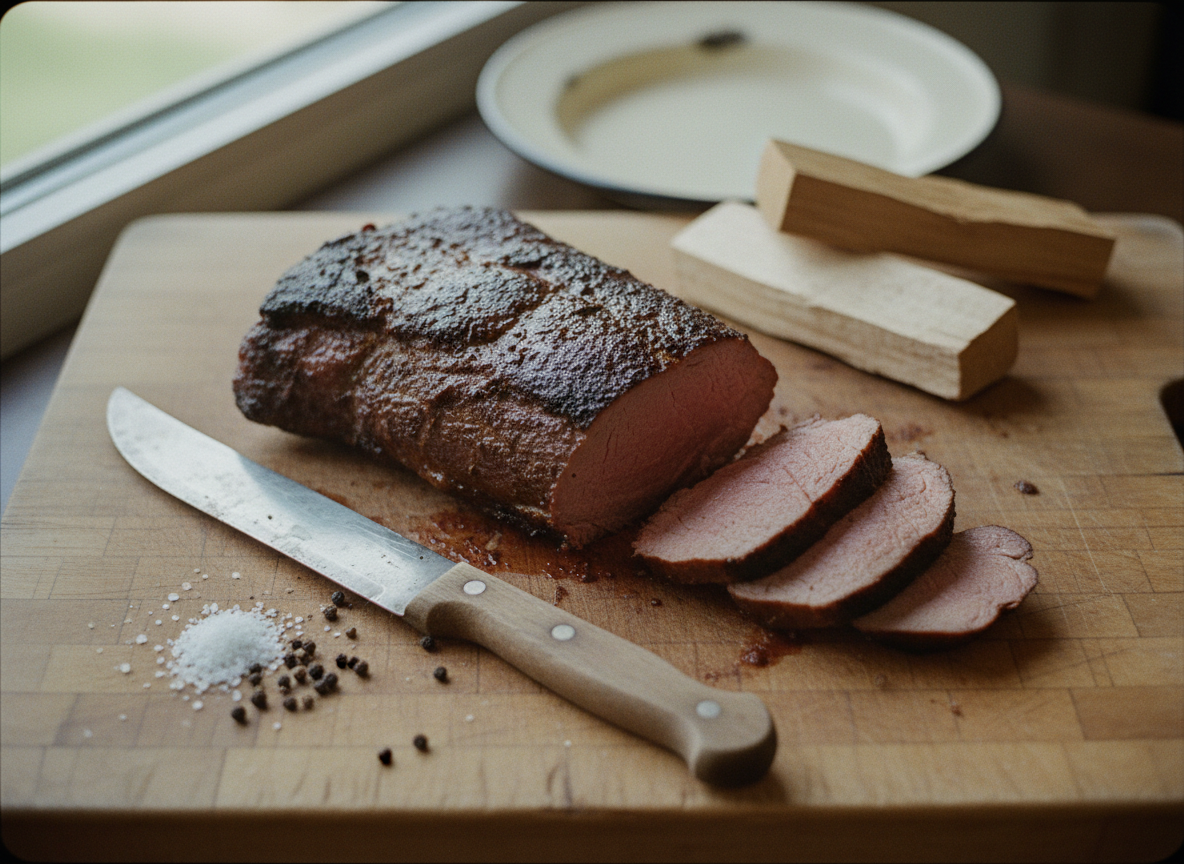
A smoked venison backstrap is the easiest cut on a deer to cook well and the easiest one to ruin, and the reason is the same either way: there is no fat in it to forgive you. A beef ribeye carries enough marbling to survive an extra fifteen minutes of heat. A whitetail loin does not. It goes from deep pink and tender to grey and dry with almost nothing in between, and most of the people who say they do not care for venison have been handed the dry version more than once.
The method below takes about two hours, and most of that is waiting. It works the same on a pellet grill on the patio, a drum smoker, or a stick burner out behind the shop.
What You Need for a Smoked Venison Backstrap
- One whole backstrap, 1.5 to 2.5 pounds, silverskin off.
- Coarse salt and cracked black pepper. That is the whole rub, and it is enough.
- A smoker held at 225 degrees — anything that will hold a low temperature for ninety minutes.
- Two or three chunks of pecan, post oak or hickory. Mesquite only if you cut it with something milder.
- An instant-read thermometer. Not the dial gauge in the smoker lid.
- A cast iron skillet or a grate over hot coals for the sear at the end.
- Time: 60 to 90 minutes of smoke, 3 minutes of sear, 10 minutes of rest.
No marinade, no bacon weave, no cream-of-something. A backstrap that needs to be hidden was handled badly somewhere upstream of the kitchen.
Trim It Before It Ever Sees Smoke
Pull the silverskin. All of it. That thin, pearly sheet of connective tissue on the outside of the loin does not render and does not soften, and it shrinks tight as it heats — which is what curls a backstrap into a banana on the grate and makes it cook unevenly end to end. Work a thin blade under one corner, get a grip on the flap with a paper towel, and peel it back against the knife in long strips.
A stiff kitchen knife fights you on this. A flexible blade follows the muscle instead of carving into it, which is the difference between losing a little silverskin and losing a quarter inch of loin down its whole length. A Victorinox Fibrox boning knife is the standard answer in most hunting kitchens. The Fibrox boning line comes in stiff and flexible versions at the same length, so check the listing says flexible before you order.
Then square the ends. A backstrap tapers, and the thin tail will be overdone by the time the thick middle is right. Cut the last three or four inches off and save it for the grind or for kabobs. Trying to cook a tapered loin to one temperature is the second most common way this goes wrong.
Salt it and let it sit on a rack in the refrigerator, uncovered, for an hour or up to overnight. The surface dries slightly, which is what lets smoke stick and what lets the sear happen fast at the end instead of steaming. Pepper goes on just before it hits the smoker, because black pepper turns bitter over long heat.
Wood: Go Easy on the Mesquite
There is mesquite in every fence line and draw from Childress to Dalhart, so it is what most people out here have stacked by the shop, and it is the wrong wood to use alone on a lean cut that only sits in smoke for an hour. Mesquite throws a heavy, resinous smoke that reads as harsh on venison in a way it does not on brisket, where nine hours and a fat cap smooth it out.
Pecan is the better local choice and there is plenty of it in the Panhandle and the Rolling Plains. Post oak, hickory and apple all work. If mesquite is what you have, burn one small chunk of it alongside two of something milder and you get the flavor without the back-of-the-throat bite.
Keep the smoker at 225. Lower drags the cook out long enough to dry the outside, and higher takes away the margin that makes this method work in the first place.
Low Heat First, Then a Hard, Fast Sear
This is a reverse sear, and it exists because of the problem lean meat creates. Sear a backstrap first and finish it slow and you get a thick grey band under the crust. Smoke it slow first and sear it last and the pink runs nearly wall to wall.
Lay the loin on the grate and leave it alone. No flipping, no mopping, no spritzing. A two-pound backstrap at 225 generally takes 60 to 75 minutes to reach 120 degrees in the thickest part, but that number moves with the weather — a twenty-mile-an-hour north wind pulls heat off a smoker body hard enough to add half an hour, which is an ordinary November afternoon here.
At 120 degrees internal, pull it and get a cast iron skillet ripping hot with a spoon of tallow or neutral oil. Ninety seconds a side, long enough to build a crust and no longer. A heavy pan holds its heat when cold meat hits it, which is the whole trick; a thin pan drops forty degrees on contact and you end up gently warming the outside instead of browning it. A plain cast iron skillet is the right tool, and these come in 6-inch through 15-inch — a 10- or 12-inch is what fits a whole loin without crowding it.
Then rest it ten minutes on a board before a knife touches it, and slice across the grain into half-inch medallions. Cutting it hot dumps the juice onto the cutting board.
Pull It by Temperature, Not by Time
Every number above is a rough guide. The only one that decides whether this works is the internal temperature, and the window on a lean loin is about ten degrees wide.
The USDA’s guidance for whole cuts of game is 145 degrees with a three-minute rest, listed on the federal safe minimum cooking temperature chart. Plenty of hunters pull backstrap below that and serve it medium-rare, and that is a choice worth making knowingly rather than by accident. Either way, carryover heat from the sear and the rest pushes the center up another five to ten degrees after the loin leaves the pan, so come off the heat below whatever you are aiming for.
Guessing by feel on a cut this lean is how grey backstrap happens. An instant-read thermometer reads the center in a few seconds through the side of the loin, and it is the same tool that tells you whether a quarter in the cooler is actually holding temperature. Check the listing for the read time — two to three seconds gets used, ten seconds gets left in a drawer.
Probe the thickest part from the side and stop when the reading stalls. Pushing the tip out the far side reads the air inside the smoker and tells you the meat is twenty degrees cooler than it is.
Where Smoked Venison Backstrap Usually Goes Wrong
Five things account for nearly all of it, and four of them happen before the smoker is lit.
The silverskin stayed on. The loin curls, cooks unevenly, and eats chewy no matter what temperature it came off at.
The tapered tail was left attached. One end is right and the other is ruined, and the cook blames the deer.
It went on frozen or half-thawed. The outside is done long before the middle is warm. Thaw it fully in the refrigerator — a day and a half for a whole loin.
The smoker ran hot. At 300 degrees the ten-degree window closes to about ninety seconds of inattention.
It was sliced straight off the heat. Ten minutes of rest is not a garnish step. It is the difference between juice in the meat and juice on the board.
The Rest of the Deer
Two backstraps off a mature Panhandle whitetail come to maybe four pounds of the best meat on the animal, out of fifty or sixty pounds of boned-out venison. Twenty-seven years of guiding hunters through this country turned up the same pattern every November: the loins get cooked carefully and everything else gets ground indiscriminately and forgotten in the freezer.
Seaming the hindquarters out into their own muscles instead of running the whole thing through a grinder is where most of the eating value on a deer actually sits, and that is laid out in how to butcher a deer at home. Everything upstream of it starts with how to field dress a deer, because meat that got warm in the field will not be rescued by a smoker. Five days cold in a cooler before anything gets cut does more for a backstrap than any technique at the smoker, and how long to age venison covers that window. For the grind there are a few easy ground venison recipes and a venison chili worth a cold Sunday.
Cook the first one on a weeknight when nobody is watching and you have not promised anybody anything. Hitting the temperature once teaches more than reading about it will, and after that a smoked venison backstrap is a ninety-minute job you can run without thinking about it. More on the animals is on the whitetail deer guide, and the kitchen and field kit is on the Recommended Gear page.
Leave a Reply