
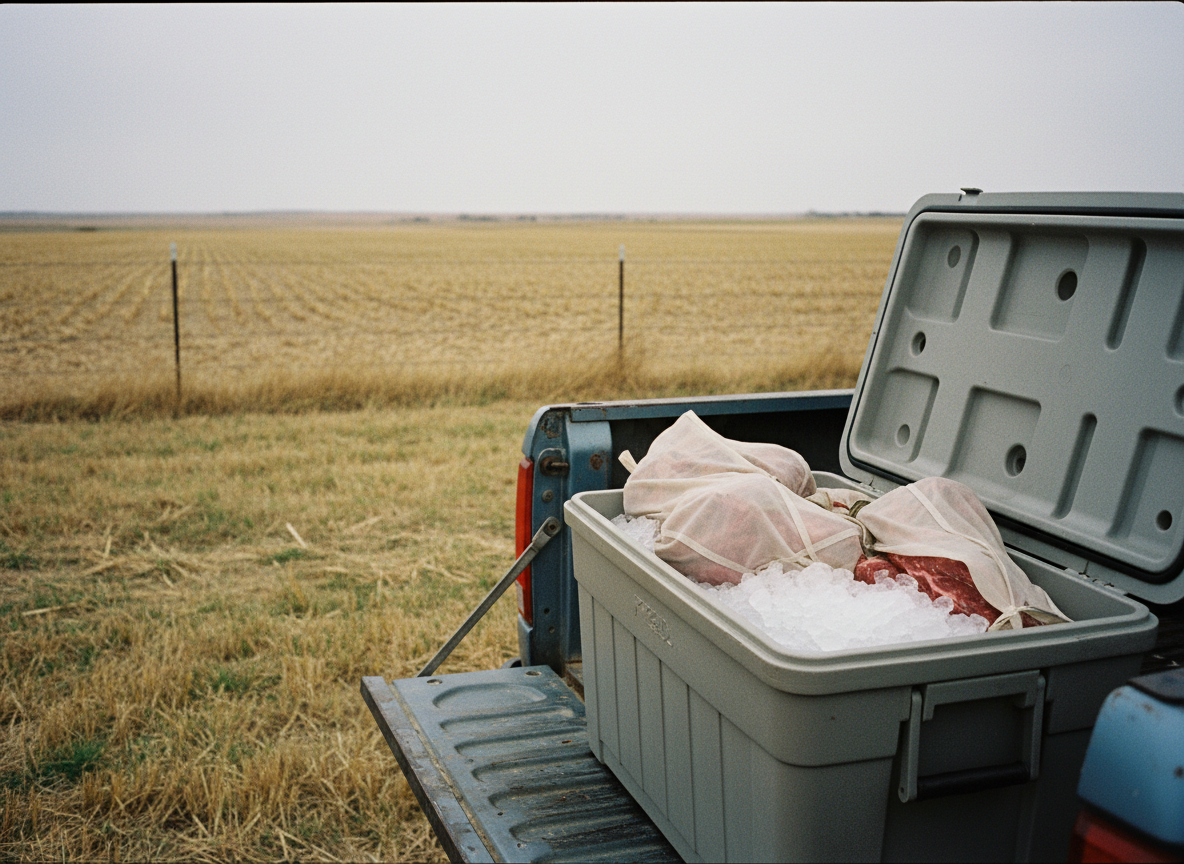
Most hunters decide how long to age venison by how much time they have, which is why so much Panhandle deer meat gets cut up the same night it hits the ground. The honest answer is five to seven days, and it depends far more on temperature than on the calendar. In this country that means a cooler and a bag of ice rather than a rafter in the barn — a 34-degree night in early November buys you nothing when the shed hits 68 by two in the afternoon.
How Long to Age Venison: The Short Answer
If you only read this far, the window to age venison well looks like this:
- 5 to 7 days at 34 to 38 degrees covers most deer, and a cooler full of ice holds that without much effort.
- Below 32 degrees aging nearly stops. Frozen meat ages not at all.
- Above 45 degrees you are not aging, you are spoiling. There is no version of this where warm is faster.
- A young doe, killed clean and cooled fast: 3 to 5 days is plenty.
- A mature buck, especially one that ran: 7 to 10 days, if you can hold the temperature.
- Gut-shot, badly hit, or warm for hours: skip aging. Trim hard, butcher, freeze.
- Aging happens before freezing. Thawing a quarter and leaving it in the fridge a week does not give back what you skipped.
What Aging Actually Does to the Meat
Within a few hours of the shot a deer goes into rigor and the muscle locks up hard. That is the state most tailgate-butchered venison gets wrapped in, and it is the best single explanation for why people think deer meat is tough. It was tough. It was also three hours old.
Over the following days, enzymes already in the muscle cut apart the proteins holding the fibers rigid. Rigor releases, the meat relaxes, and the texture changes noticeably between day two and day five. A little surface moisture leaves at the same time, which concentrates what flavor the animal has. None of this is bacterial. It is a slow chemical process with a narrow temperature band, and the band is the whole trick.
Temperature Decides Everything
Raw meat belongs at or below 40 degrees, the line drawn on the USDA’s cold food storage chart. Aging works in the narrow strip just under it — roughly 34 to 40 degrees, where enzymes stay active and bacteria stay slow. Past 45 the bacteria win the race. Below freezing, nothing happens at all.
That is easy enough in a Michigan garage in November and a real problem here. The Panhandle swings 35 to 40 degrees between dawn and mid-afternoon through most of deer season, so a carcass hanging in an uninsulated barn sits above the line for six or seven hours a day even in a week that averages cold. The National Weather Service office in Amarillo posts hourly observations for Amarillo, Dalhart, Dumas, Borger and Perryton; one look at an afternoon high against the overnight low explains why hanging deer never caught on out here.
Measure it rather than trusting it. Air temperature inside a cooler is not meat temperature, and a hindquarter takes most of a day to catch up to the ice around it. An inexpensive instant-read thermometer pushed two inches into the thick of a quarter settles the question in ten seconds, and it is the same tool you want at the skillet later.
Wet Aging, Dry Aging, and Why Venison Is Different
Dry aging works on beef because beef carries a thick fat cap and heavy marbling: the outside dries to a hard rind, the rind gets trimmed away, and the fat underneath pays you back for everything the trim cost. Venison has none of that. No fat cap worth the name and essentially no intramuscular fat, so air-drying a venison quarter dries straight into the muscle — two weeks in open air costs a pound or more per quarter of gray, leathery exterior and returns very little.
So most hunters who age venison in a cooler are doing something closer to wet aging, and that is the right call. The quarters sit cold, in breathable bags, with the surface just barely crusted. The one thing that ruins it is standing water. Meat on ice ages; meat sitting in bloody meltwater goes slick and sour at the surface inside two days. Crack the drain plug, leave it cracked, and prop the low end of the cooler up on a block.
Breathable bags are what make that work. Reusable ripstop game bags let the surface give up moisture and firm up, which is what you want over five days, where a quarter sealed wet in a contractor bag sours against the plastic. Game bag sets are sized by the bag, not by the deer — a quartered whole deer needs four large bags plus one for loose trim, so a five-pack is one deer, not two.
If you have a spare refrigerator and want true dry aging, UMAi Dry makes a breathable membrane bag built for it, which lets a backstrap dry in a normal fridge without picking up the smell of everything else in there. Different project than the cooler, and worth it on a cut you care about.
How to Age Venison in a Cooler
The method is unglamorous and it has not changed in decades.
- Get the hide off the same evening. A hide insulates a dead deer as well as a live one, and hindquarters hold body heat for hours underneath it. The full sequence is in how to field dress a deer.
- Quarter it and bag the quarters. Breathable bags, never plastic.
- Build it in layers. Block ice on the bottom, quarters above it, bagged ice on top. Cold falls.
- Keep the drain open and prop the low end up, so meltwater leaves on its own.
- Check it daily. Pour off, add ice, feel the quarters. Two minutes.
- Pull it at five to seven days. The meat should be firm, deep red, the surface dry and slightly tacky.
What you are listening for on day six is nothing. Properly aged venison smells faintly of iron and cold water. Sour, sweet or barnyard means it got warm somewhere, and the fix is to trim to clean meat and cook it soon rather than hope another day sorts it out.
Holding ice for a week in a shed that hits 70 in the afternoon is where most coolers fail. A Yeti Tundra 65 is heavy and expensive and that is the reason people buy one anyway — thick rotomolded walls and a gasketed lid keep ice alive across the whole aging window instead of the first two days of it. The Tundra line jumps from 45 quarts to 65 with nothing in between, and a quartered whole deer plus a week of ice needs the 65.
When Not to Age Venison at All
There are real reasons not to age venison, and recognizing them saves more meat than the aging would have improved.
A gut shot. Paunch contents on muscle is contamination, and five days of aging is five days for it to work deeper. Trim the affected meat away without being sentimental about the weight, butcher the rest, freeze it.
A long chase. A deer that ran hard before it died burns the muscle glycogen that would otherwise drop the meat’s pH as it cools. It stays firm, dark and a little dry no matter what comes next. Age it the usual week if the weather allows, but that outcome was decided by the shot.
Warm hours. A deer shot at nine in the morning in October heat and not found until mid-afternoon has already spent its aging budget sitting in the sun. Cool it, cut it, freeze it.
A young doe killed clean. Three days and she is as good as she will get. Past a week you are only losing trim to the surface.
After the Aging Is Done
Butcher within a day or two of pulling the quarters out. Deboning along the seams rather than sawing across bone is the whole job, and it is laid out in how to butcher a deer at home.
Take the trouble to age venison properly and the freezer is where that work gets protected or thrown away. Paper-wrapped venison burns in four to six months; vacuum-sealed holds a year or better, and a FoodSaver FM2100 is the machine most hunting households settle on. Freeze ground meat into flat one-pound bricks before sealing, or the vacuum pulls mince through the seal and you lose the bag.
Label everything with the cut and the date. A careful week of aging is wasted on a package you cannot identify in February.
Give It the Week
Twenty-seven years of guiding hunters through this country turned up a pattern worth passing on: the men who said venison was tough and gamey were almost always the ones who had it wrapped and in the freezer before midnight. The deer was rarely the problem. The schedule was.
Five days in a cooler costs two minutes a day and a bag of ice, and it does more for the meat than any marinade will. More on the animals is on the whitetail deer guide, a few easy ground venison recipes will move through the grind, and the rest of the kit is on the Recommended Gear page.
Leave a Reply