
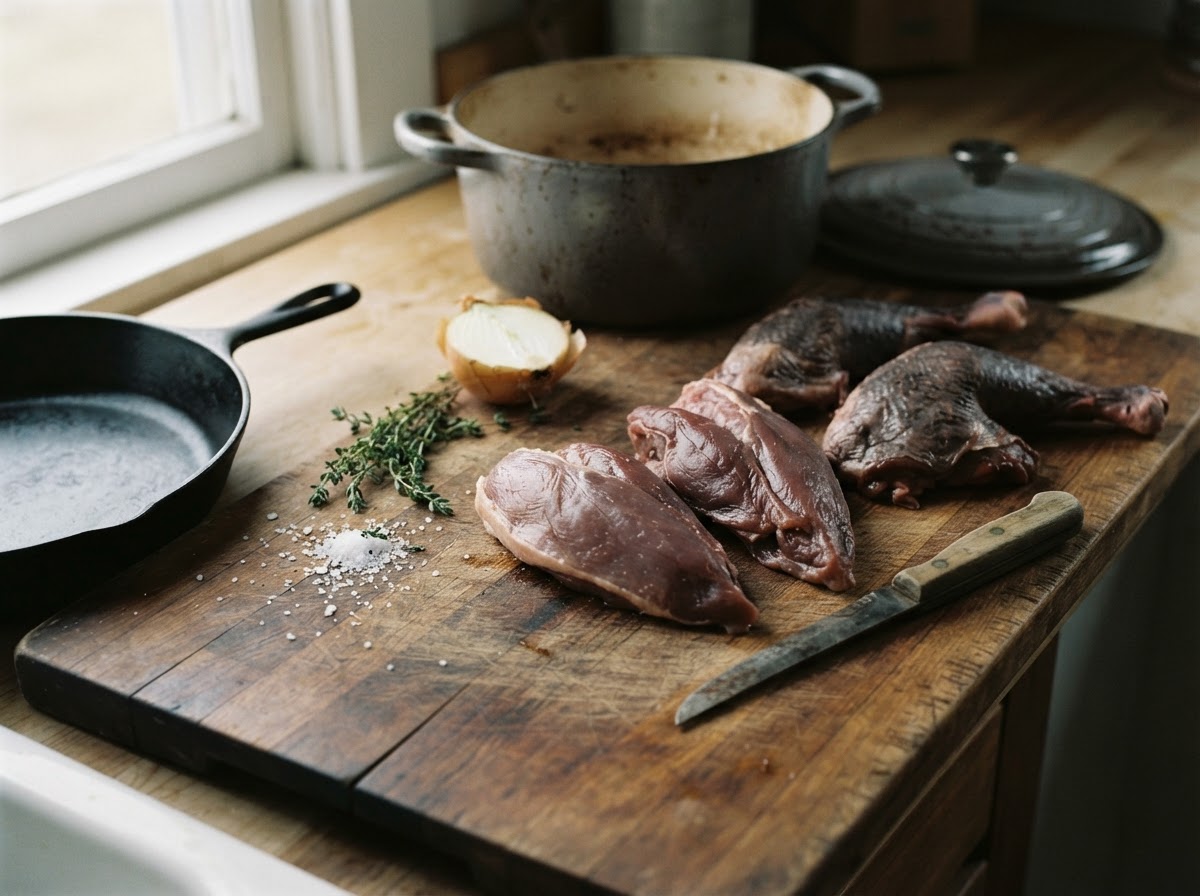
Most people learn how to cook a wild turkey the hard way, by treating it like the frozen bird from the grocery store — rubbing it with butter, putting it in a roasting pan whole, and pulling out something with chalky breast meat and legs nobody can chew. The bird did not fail. The recipe did. A Rio Grande gobbler and a Butterball have almost nothing in common except the word turkey, and the single change that fixes nearly everything is to stop cooking it in one piece.
How to Cook a Wild Turkey: Break the Bird Down First
If you take one thing from this, take this:
- Separate the breast from the legs and thighs. They need opposite cooking methods. This is the whole trick.
- Breast: brine 6 to 12 hours, then roast hot and fast to 165 degrees. Twenty-five to forty minutes, not three hours.
- Legs and thighs: braise low and wet for two and a half to three hours until a fork twists the meat apart.
- Wings and neck: stock. They are not worth eating and they make the best broth on the bird.
- Never roast a wild turkey whole unless you have already decided the legs are getting thrown away.
- 165 degrees is the number, measured, not guessed.
Everything below is detail on those six lines.
Why a Wild Bird Is Not a Butterball
A supermarket turkey is a broad-breasted white, bred over decades for one trait: an enormous breast on a bird that never walks anywhere. It carries real fat under the skin and through the meat, and it is usually injected with a salt solution on top of that. You can roast it whole badly and still eat it.
A Rio Grande gobbler off the Panhandle weighs sixteen to twenty pounds live and spends every day of its life walking. It crosses pastures, roosts in cottonwoods along the Canadian River and the creek bottoms, and runs when it wants to. That produces a breast with almost no intramuscular fat and legs and thighs laced with connective tissue, built the way a working animal’s legs are built.
So the breast behaves like a very lean pork loin: cook it fast, pull it on time, and it is excellent. The legs behave like beef shank: they need hours of moist heat to turn that connective tissue into gelatin, and there is no shortcut. Put both in the same pan at the same temperature and one of them is guaranteed to be wrong.
Breaking a bird down takes about ten minutes once you have done it twice. Follow the keel bone down with the tip of the blade, take each breast half off in one piece, then pop the leg quarters at the hip joint. A flexible Victorinox Fibrox boning knife follows bone instead of fighting it, which is most of the job. The Fibrox boning line comes in stiff and flexible at the same blade length — the flexible one is what you want for poultry.
Brine the Breast, Not the Whole Bird
A wild turkey breast has no fat to hold moisture, so salt has to do that work instead. A wet brine of roughly one cup of kosher salt to a gallon of cold water, with the breast halves fully submerged, for six to twelve hours in the refrigerator. Longer than overnight and the texture starts going spongy and ham-like.
Add whatever you like to it — brown sugar, peppercorns, bay, a few crushed garlic cloves, a split jalapeño — but the salt and the water are what matter. Everything else is seasoning around the edges.
Pull the breast out, rinse it, and dry it hard with paper towels. Then let it sit uncovered on a rack in the refrigerator for an hour if you have the time. Wet skin steams instead of browning, and a dry surface is the difference between color and pale.
Skip the brine on the legs. They are going into liquid anyway.
Roast the Breast Hot and Fast
Oven at 400 degrees. Breast halves on a rack over a sheet pan, skin side up, rubbed with oil or softened butter and seasoned. Twenty-five to forty minutes depending on the size of the bird, and that range is wide because a jake’s breast and an old gobbler’s breast are not the same piece of meat.
Start checking the internal temperature at twenty minutes. That is not caution, it is the whole method — the window between done and dry on a lean breast is about ten degrees, and nothing in the appearance of the meat tells you where you are inside it.
If you would rather not roast it at all, a brined wild turkey breast sliced into cutlets, pounded thin, dredged and pan-fried in cast iron is the best thing you can do with the cut and it takes four minutes. Plenty of households out here never cook it any other way.
Braise the Legs and Thighs
This is the part most hunters throw away, and it is the better half of the bird once it is cooked right.
Brown the leg quarters hard on all sides. Then set them in a heavy pot with chopped onion, carrot, celery, a couple of bay leaves and enough stock, beer or water to come about two thirds of the way up the meat. Lid on, oven at 300 degrees, two and a half to three hours. It is done when a fork twists a piece of thigh meat apart with no resistance — not at a temperature, at a texture.
A heavy enameled pot holds a low oven steady and seals well enough that the liquid does not cook away over three hours. An enameled cast iron dutch oven in the 6-quart size takes a whole bird’s leg quarters; these run from about 4 quarts up to 7, and 4 is too small for four leg quarters plus liquid.
Pull the meat off the bone, shred it, and put it back in the strained cooking liquid. From there it goes into tacos, enchiladas, a pot pie, green chile stew, or over rice. A pressure cooker does the same job in about forty-five minutes if you would rather not run the oven all afternoon.
Temperature Is the Only Thing That Matters
Poultry is one of the few places where the safe number and the good-eating number are the same. The USDA puts all poultry at 165 degrees, listed on the federal safe minimum cooking temperature chart, and a wild turkey breast is genuinely good right at 165 — there is no medium-rare argument to have here the way there is with venison.
What that means in practice is that you pull it a little early. Carryover heat pushes a roasted breast up another five degrees or so while it rests, so coming out of the oven around 158 to 160 and resting ten minutes lands you on 165. Waiting until the thermometer reads 165 in the oven puts you at 170 on the plate, and 170 is where chalky starts.
Probe the thickest part of the breast from the side, not down through the top, and stop pushing when the number stops falling. An instant-read thermometer settles it in a couple of seconds. Check the read time on whichever one you buy — a two-second probe gets used every time and a ten-second one gets left in the drawer.
A Fall Bird and a Spring Bird Are Different Meat
A fall or winter bird is usually the better one to eat. Spring gobblers are run down from weeks of strutting and fighting and come in lean and stringy by comparison, while a fall bird has been feeding on waste grain and insects and carries more condition. A fall jake or young hen is the best eating turkey most people will ever put on a table.
Fall turkey in the North Zone runs November 7 through January 3, per TPWD’s 2026–2027 season dates — but a lot of High Plains counties have no fall season at all, so check your specific county rather than the zone. Spring in the North Zone opens April 3 and closes May 16, 2027. The rest of the dates are collected in the Panhandle season dates post.
An older gobbler is not a lost cause, it is a braising bird. Brine and roast the breast off a young one; take an old one’s breast and braise it with the legs, or grind it. Matching the method to the bird is most of what separates people who like wild turkey from people who have decided they do not.
Worth the Trouble
Twenty-seven years of guiding hunters through this country produced a reliable pattern: the hunters who came back for turkey every spring were the ones who had eaten one cooked properly, and the ones who quit after a season had roasted their first bird whole.
Break it down, brine the breast, braise the legs, and own a thermometer. That is the entire argument. If you are working on getting a bird in the first place, the complete guide to Rio Grande turkey hunting covers the hunting side, the turkey hunting guide has the species background, and the kitchen and field kit is on the Recommended Gear page.
Leave a Reply