
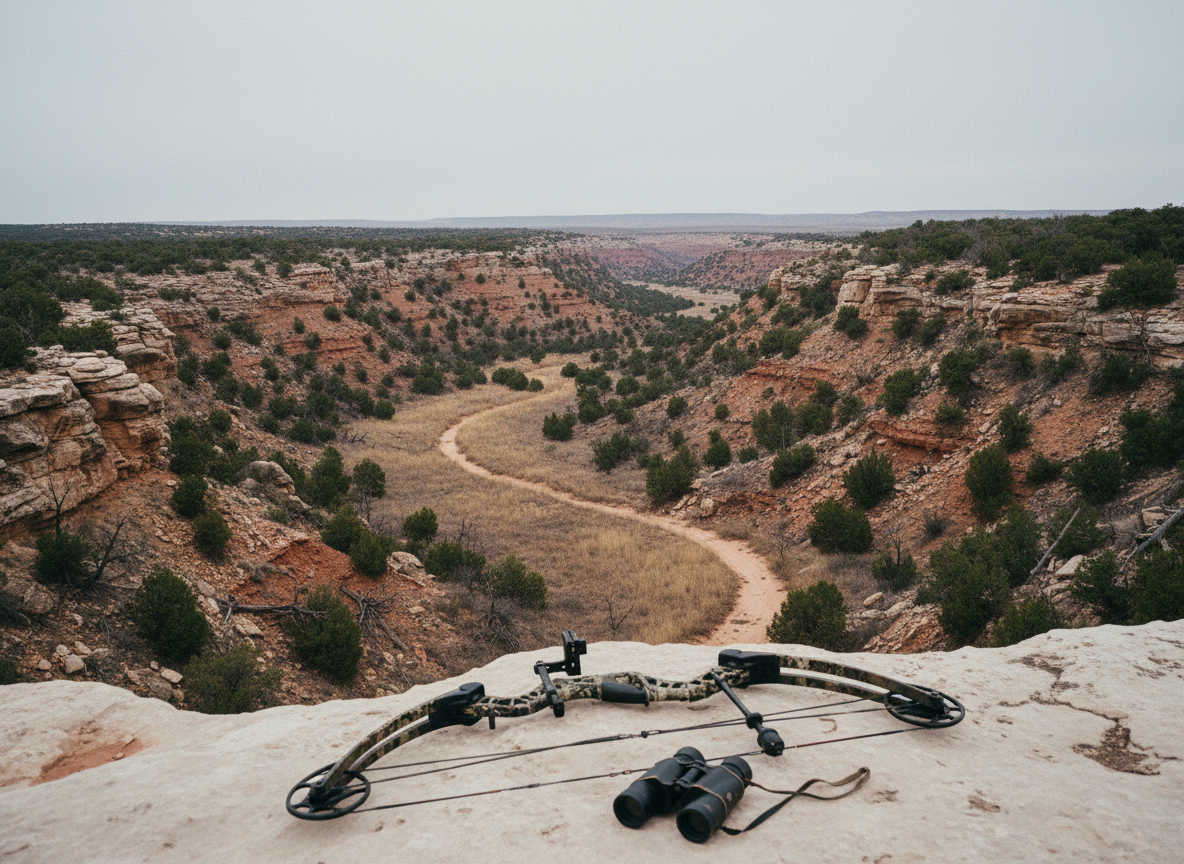
Most archery whitetail tactics that work in East Texas pine or Hill Country cedar fall apart the first morning you try them in the Caprock breaks. A buck can bed on a shaded slope three hundred feet below you, feed in wheat a half mile out on the flat, and never once walk through the kind of tight timber funnel a bowhunter is taught to look for. The country is open where you want cover and broken where you want sightlines. Getting inside forty yards of a mature deer in it takes a different approach than the one in the magazines.
What the Caprock Actually Looks Like to a Bowhunter
The Caprock Escarpment is the line where the flat High Plains break off and drop onto the Rolling Plains below. In some places it’s a gentle step down you’d drive across without noticing. In Palo Duro and Tule Canyon it’s several hundred feet of red rock and juniper, with side canyons forking off the main drainage like veins off an artery. The Canadian River breaks up north and the Red River breaks to the east do the same thing on a smaller scale.
That terrain sorts itself into three layers, and deer use all three in a single day.
On top is farm ground — wheat, milo, cotton, and shallow playa basins that hold water for a while after a rain. Down in the breaks are redberry juniper pockets, shinnery oak, mesquite, and sandy draws with enough shade to run twenty degrees cooler than the open flat at two in the afternoon. In the bottoms there’s hackberry, cottonwood, and whatever water hasn’t gone dry.
Deer bed in the breaks, feed on top, and water somewhere in between. The fact that those three things sit in three separate places is the best thing a bowhunter has going out here. Flat country gives a deer a hundred ways to get from bed to food. The breaks give him four.
Archery Whitetail Tactics That Work in Broken Country
The single most useful thing to understand is that deer travel the contour, not the fall line. A whitetail leaving a bed on a canyon slope does not climb straight up the steepest pitch to reach the wheat field. He works sideways along a bench until he finds the place where the grade eases, then walks up through that. Those easings are where you hunt.
Three features produce them reliably.
The head of a draw. Where a side canyon pinches out and dies into the flat, the walls come together and the slope flattens. Every deer using that draw funnels through the last fifty yards of it. Find the head of a draw with fresh sign in the bottom and you’ve found the best stand site in that section.
Saddles on a ridge finger. The fingers of land between side canyons usually have one low spot where deer cross rather than walking all the way out to the point. They’re obvious from the opposite rim and nearly invisible when you’re standing on them, which is why most hunters miss them.
Benches. A flat shelf partway down a slope is a deer highway and a bedding area at the same time. Deer walk the length of it because it’s the only easy footing between the rim and the bottom. Hunt the downwind end.
Twenty-seven years of guiding hunters through this country taught the same lesson over and over: the man who hunted the terrain out-killed the man who hunted the food, every season, without exception. Food moves with the crop rotation. A saddle is in the same place it was ten years ago.
Spot-and-Stalk Is Actually on the Table Here
This is the part that surprises hunters coming from timber. In the breaks you can glass whitetail the way westerners glass mule deer, because you have elevation and you can see across.
Sit the rim at gray light with binoculars and watch the opposite slope. Deer coming off the wheat drop into the breaks in the first half hour of daylight, and if you’re patient you’ll watch one bed. Mark the spot against a landmark you can find again — a dead juniper, a caliche slide, a lone yucca. Then leave, swing wide, and come in on him from above when the thermals settle.
Be honest with yourself about the odds. Most stalks end with a deer standing up at eighty yards and leaving. The footing is loose shale and caliche that rolls, and dry juniper duff is loud. But a stalk that fails costs you a morning, not a season, and it beats sitting a bad stand in the wrong wind.
A pocket wind checker earns its two dollars here more than any other piece of gear. Canyon air does whatever the terrain tells it to, and a puff of powder will show you a swirl that your face never felt. Hunter’s Specialties Windicator is the standard one — unscented talc in a squeeze bottle that fits a shirt pocket. Check it every time the terrain changes shape, not just when you set up.
Setting Up Where There Is No Perfect Tree
Nobody warns you about this until you’re standing in a draw with a stand on your back and nothing to hang it on. Redberry juniper is short, bushy, and multi-trunked. Hackberry is brittle. Mesquite is worse. Cottonwood is big enough but only grows in the bottoms, which is often not where the deer are.
Two things make this workable.
First, hang low. Terrain is already giving you the elevation that a stand gives a timber hunter. If you’re set up on the upslope side of a bench, a deer walking that bench is below your feet at ten or twelve feet. Chasing twenty feet in a tree that won’t hold it is how people get hurt for no gain.
Second, quit looking for a tree and build a ground setup instead. A cedar pocket with the middle cut out of it is the best natural blind in this country — dark inside, rooted in place, and it already smells like everything else on that slope. Cut from the back, leave the silhouette of the outside intact, and clear the floor down to dirt so you’re not standing on crunch.
A folding saw does most of that work. The Corona RazorTOOTH 10-inch cuts juniper faster than a saw that size has any right to, and it folds into a pack pocket. Pruning shears handle the shinnery.
Scout Hard Without Burning the Place Down
A canyon holds scent and sound in a way open country doesn’t. Walk a draw bottom at dawn to check a camera and you’ve told every deer on that slope exactly where you were and when. The breaks punish repeat intrusion harder than flat ground does.
Cellular cameras are the honest fix. The Tactacam Reveal X 3.0 hunts on multi-carrier LTE, which matters when half the Panhandle has one bar of one network and nothing else. Hang it on the head of a draw or over a water source, then leave that canyon alone for a month and read the pictures from your truck.
When you do have to go in on foot, go at midday, go once, and take care of everything in that trip. The groundwork for all of this — reading sign and figuring out where deer are headed before the season opens — is covered in more detail in how to pattern a Panhandle whitetail before archery season.
Early October Heat Is the Real Enemy
Archery season opens while it’s still summer out here. Ninety degrees in the first week is normal, and it changes two things.
Deer movement compresses into the last twenty minutes of shooting light and the first ten of morning. Evening sits over water or a field edge beat morning sits badly in the early season, which is the reverse of what most hunters default to. And a deer that beds in a shaded juniper pocket at eight in the morning is not getting up again until the sun is off that slope.
The other thing heat changes is what happens after the shot. A deer down at seven in the evening with the air still at eighty-five degrees needs to be opened up and cooled within the hour, not after a leisurely walk back to the truck for a light. Carry what you need to do it on the spot — the step-by-step is in how to field dress a deer. Losing a good buck to spoilage in the first week of October is an entirely avoidable mistake and it happens every year.
Getting Access to Canyon Country
Almost all of this ground is private, which is the honest answer and also not the end of the conversation.
The Annual Public Hunting Permit from Texas Parks and Wildlife is the cheapest real access in the state — nearly a million acres across more than 180 areas, walk-in, no drawing — and it covers wildlife management areas in and around the breaks. Separately, the TPWD public hunt drawing puts archery hunters on WMA and state park units that never see general pressure, and the odds on archery-only categories are better than people assume because fewer hunters apply. Both are worth the application fee even in a year you don’t draw.
For private ground, the approach that works is the unglamorous one. Knock in the spring, not in October. Ask about hogs first. Landowners along the breaks deal with feral hog damage constantly, and a hunter who shows up in March offering to help with pigs is a different proposition than one who shows up the week before opening day asking about deer. A guided hunt through a local outfitter also solves access in one step if your time is worth more than your patience. Season dates and unit specifics are worth confirming against the current Texas Panhandle hunting season dates before you plan around anything.
If the private ground becomes a written lease, settle the liability question before you sign rather than after. The American Hunting Lease Association sells liability coverage built specifically for hunting leases, covering both the hunters on the lease and the landowner. Read what your lease says about insurance, then decide who is carrying it.
The lease insurance link above is an affiliate link — we may earn a referral fee if you buy a policy, at no additional cost to you. We are not insurance agents and this is not insurance advice. See our affiliate disclosure.
Where to Start
If you have one section of breaks to learn and limited time, spend the first morning on the rim with binoculars instead of in a stand. Find the heads of the draws and the saddles on the fingers, and watch where deer actually cross. You’ll learn more in three hours of glassing than in three weeks of guessing, and you’ll pick a stand site you can hunt for the next ten seasons. More on the species itself is on the whitetail deer guide, and the gear worth carrying is on the Recommended Gear page.
Leave a Reply