
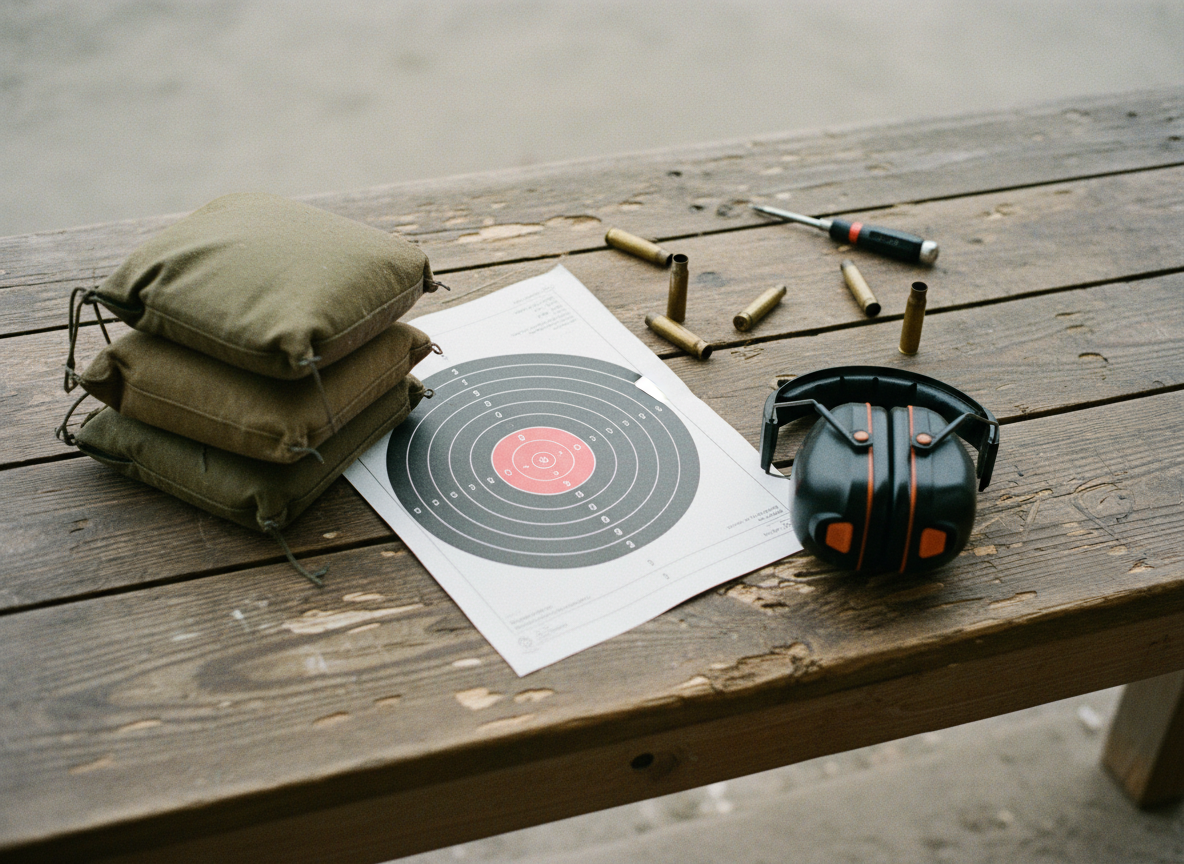
The North Zone general season opens November 7, which leaves most hunters two weekends to sight in a rifle that has been in a case since January. That is plenty of time. It is also more time than most people use. We outfitted hunts in this country for 27 years, and the rifles that showed up shooting honest groups were the ones somebody had checked after the mounts were torqued and before the wind came up — not the ones that got three rounds fired at a feed sack on the drive out.
Why Panhandle Conditions Change the Job
A zero is not a permanent setting. It is a record of where the rifle was shooting on one particular day, in one particular set of conditions, with one particular box of ammunition.
Out here, all three of those move. Amarillo sits around 3,600 feet and Dalhart higher still, so a load worked up near sea level will not print where its box says it does. A rifle zeroed in 95-degree July heat behaves differently on a 28-degree November morning, because powder burns differently cold. And the drive to most Panhandle leases involves miles of washboard caliche road, which is the single most effective scope-loosening machine ever built.
Then there is the distance problem. In canyon breaks and wheat stubble you can see a long way, and a half-inch error at 100 yards is a two-inch error at 400. The flat open ground that makes this country good hunting is the same ground that punishes a sloppy zero.
Start With the Mount, Not the Target
Most rifles that will not hold a group are not inaccurate. They are loose. Before you burn a single round, pull the rifle out of the stock mentally and check three things: the action screws, the base screws, and the ring caps.
Torque them to a number, not to feel. Feel is reliably wrong, and it is wrong in the direction of too tight — overtorqued ring caps will dent a scope tube and overtorqued action screws will squeeze a stock into shooting badly. Rough figures are 15 to 18 inch-pounds on ring caps, 25 to 30 on base screws, and whatever the manufacturer specifies on the action, but follow your specific hardware over any general number.
A Wheeler FAT Wrench or any honest inch-pound driver removes the guesswork for about the cost of two boxes of ammunition, and it is the cheapest thing on this page that will actually change your groups. Wheeler sells it in a few versions, including a digital one and different bit sets, so check the torque range and what bits are included on the listing before you order.
Blue thread locker on base screws, nothing on ring caps. Level the reticle to the rifle rather than to the bench, and if you have a bore sighter or a laser cartridge, use it — getting on paper before you start shooting saves a surprising amount of ammunition at current prices.
How to Sight In a Rifle at 100 Yards
The process is short and most people rush the only part that matters, which is letting the barrel cool.
- Set up on something genuinely solid. A lead sled or a front rest and rear bag takes you out of the equation so the rifle can show you what it does.
- Fire one round at 25 yards first to confirm you are on paper, then move to 100.
- Shoot a three-shot group. Not one shot — three.
- Let the barrel cool five to ten minutes. A hot sporter barrel walks, and the group it gives you after six fast rounds is not the group you will shoot on a cold November morning.
- Adjust from the center of the group, not from the last hole. At 100 yards a quarter-MOA click moves impact about a quarter inch, so a two-inch correction is roughly eight clicks.
- Fire a fresh three-shot group to confirm the adjustment took. Turrets occasionally do not move when you tell them to, and you want to find that out now.
The mistake that costs the most ammunition when people sight in a rifle is chasing single shots around the target — adjust, fire one, adjust again, fire one. That is not zeroing a rifle, it is following the natural scatter of a three-shot group with the turrets, and it can go on for a whole box without ever converging.
Use targets with a visible point of aim and bullet holes you can actually see at 100 yards. Birchwood Casey Shoot-N-C bullseyes are the standard for a reason: the adhesive coating peels back bright chartreuse around every hole, so you can call your shots through the scope instead of walking down range after each group. One thing worth checking before you order — they come as 6-inch, 8-inch, 12-inch and 17-inch bullseyes and in several different pack counts, and the one linked here is the 6-inch. Six inches is plenty at 100 yards through glass. If you are shooting iron sights, or confirming at 200 and 300, size up.
For the rest itself, a Caldwell DeadShot front and rear bag combo is the cheapest honest way to take yourself out of the equation. The front bag carries the forend and the rear bag cradles the toe of the stock, so the rifle returns to the same place between shots instead of wherever your arms have drifted to. Check whether the set you are ordering arrives filled — several versions of these ship empty on purpose, to keep the shipping weight down, and you fill them with sand yourself.
The Caldwell Lead Sled DFT is the step up from bags, and it earns its place if you are zeroing anything that kicks. The rifle sits in a frame you can weight down with sandbags or shot, which takes your flinch and a good share of the recoil out of the equation at once — the difference shows up most on a magnum, or on a youth rifle where a flinch learned at the bench follows a kid into the field. Caldwell builds this in several frames, the DFT, the DFT 2 and the lighter Solo among them, so check which one you are ordering.
Wear hearing protection, and wear it on the first shot rather than the second. Howard Leight Impact Sport muffs are the common choice, and the electronics let you hear a range command through them, which matters if you are sighting in alongside anybody else. Howard Leight sells a few versions under the Impact Sport name — the standard one is what most people mean, and the BOLT version differs mainly in how quickly the circuit clamps down on the shot.
Pick the Zero You Will Actually Use
Decide this before you sight in a rifle, not after you have already spent the ammunition.
A dead-on 100-yard zero is simple and it is the right answer if your shots are in cedar pockets and creek bottoms under 150 yards. For most Panhandle whitetail and mule deer hunting, a 200-yard zero is the more useful setting. With a typical modern deer cartridge that puts you roughly two inches high at 100, dead on at 200, and six to eight inches low at 300 — which means that out to about 250 yards you can hold on hair and kill the deer without doing arithmetic.
Whatever you pick, get the actual drop numbers for your load and write them down. A strip of tape inside the scope cap with your zero, your load, and the drop at 200, 300 and 400 is worth more on a hunt than any app you will not have signal for.
Wind at the Range Is Part of the Test
Most people treat wind as a nuisance that ruins a range day. Out here it is a condition of the hunt, and the range is where you learn what it does to you.
At 100 yards a 15-mile-an-hour crosswind is under an inch for most deer loads, so it will not wreck your zero. At 300 it is most of a foot, and that is the number worth knowing before you need it. Shoot in the wind on purpose at least once and find out whether you can call it, because a zero confirmed only on the rare calm morning tells you very little about the Panhandle.
It helps to know what you are walking into. The National Weather Service office in Amarillo publishes current observations across the region, including Amarillo, Borger, Dalhart, Dumas, Perryton and a set of Texas Tech mesonet stations, so you can pick a morning rather than drive out and hope. At the bench itself, a Windicator powder bottle shows you what the air is doing at your position, which is often not what the flag at the far end is doing.
Heat shimmer is the other half of this. Past about 16x on a warm afternoon over caliche, mirage turns the reticle into something swimming in a glass of water, and it will also shift your apparent point of aim. Shoot early. The same thermal behavior that moves your scent in canyon country is moving the air your bullet travels through, which we went through in reading wind and thermals in canyon country.
Confirm at Distance, Then Stop Shooting
A 100-yard zero that you have never confirmed further out is a theory. Shoot a group at 200, and if you expect shots past that, one at 300. You are not looking for a tight group out there so much as confirming the rifle and your drop data agree.
If you want to know whether that zero really holds at distance, there is no cheaper confirmation than a morning of prairie dog shooting in the Panhandle — a small target, a ranged distance, and the same crosswind you will be reading in November.
You do not have to walk down range after every group. A pair of Vortex Diamondback HD 10×42 binoculars reads holes in a target at 200 and 300 yards well enough to adjust from, and they are the same binoculars that will find deer for you in November — the best argument for buying glass before buying a better scope.
Then put the rifle away. Shooting a hundred rounds the week before the season heats the barrel, fouls it differently than it will be on opening morning, and builds a flinch. Twenty well-spaced rounds tell you everything a hundred fast ones will not.
The Last Checks Before Opening Morning
- Fire one cold-bore shot from a hunting position — off a pack, off sticks, off a blind rail — rather than from the bench. That is the shot you will actually take.
- Hunt with the same ammunition you zeroed with, and ideally the same lot number. Different loads print in different places, sometimes several inches apart.
- Recheck the ring and base screws after the drive out. Caliche roads undo work.
- If a child or a new shooter is using the rifle, have them fire it from their hunting position too. Fit and recoil decide more first-deer outcomes than ballistics do, which we covered in planning a youth deer hunt in the Texas Panhandle.
- Know the distance. A confirmed zero and a guessed yardage still produces a miss, and the units that survive Panhandle glare are in best rangefinders for West Texas whitetail and mule deer.
Write down what the rifle did — the load, the group, the zero, the conditions. The next time you sight in a rifle you will start from data instead of memory, and the whole job will take one morning instead of two weekends. More on hunting this country is in our whitetail deer hunting and mule deer hunting guides, and the rest of what we point hunters toward is on the recommended gear page.
Leave a Reply