
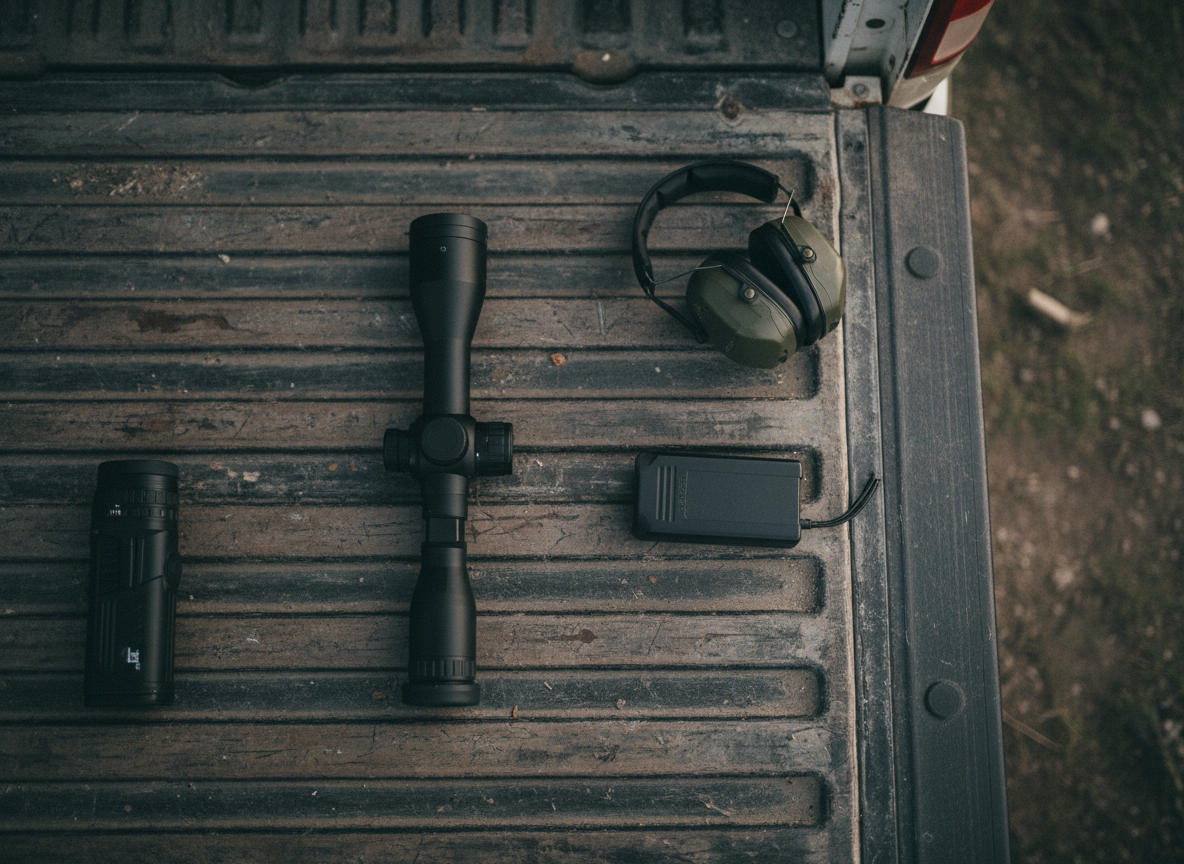
Hogs in wheat and milo country don’t stay daylight animals for long. Give a sounder two or three weeks of pressure and the whole group shifts to moving between midnight and four in the morning, working field edges and playa margins where nobody’s sitting. That’s the problem every landowner out here eventually describes the same way: fresh rooting every morning, and nothing on the ground at legal light. Finding the best thermal scope for hog hunting is really about solving that one problem — seeing animals that have already decided not to be seen.
Thermal vs. Digital Night Vision — What You Actually Need
These get lumped together and they do different jobs.
Thermal reads heat. It doesn’t need any ambient light at all, and it sees through tall grass, light brush, dust, and fog that would hide an animal completely from anything optical. On open Panhandle country a thermal picks up a hog on a field edge at several hundred yards as a bright shape against cool ground. That detection ability is the whole reason thermal costs what it does.
Digital night vision reads light. It needs some — moonlight, or more commonly an infrared illuminator mounted alongside it. It won’t find a hog in cover the way thermal will. What it does give you is a picture that looks like a photograph, which makes identifying what you’re looking at much easier, and it runs a third to a quarter of the price.
The honest version: thermal is a detection tool, digital night vision is an identification tool. If you’re covering open ground and trying to find hogs, thermal. If you’re sitting a feeder or a known crossing where you already know what shows up, digital night vision does the job for a lot less money.
How to Choose the Best Thermal Scope for Hog Hunting
Sensor resolution is the first fork in the road. A 384×288 sensor is the practical entry point and it’s genuinely enough for most hog hunting inside 200 yards. A 640×480 sensor roughly doubles the price and buys you a cleaner image at distance — worth it on the long sightlines out here if the budget allows, not necessary if it doesn’t.
NETD is the number most buyers ignore and shouldn’t. It measures how small a temperature difference the sensor can pick out, in millikelvin, and lower is better. Under 25 mK is where images start looking genuinely detailed. This matters more here than in cooler country: on a July night when the ground is still holding 85 degrees from the afternoon, the contrast between a hog and the dirt it’s standing on gets thin, and a low-NETD sensor is what keeps the picture readable.
Refresh rate should be 50 Hz. A 30 Hz unit smears on moving animals and is genuinely hard to shoot with when a sounder breaks and runs. Nearly everything current is 50 Hz, but older and off-brand units aren’t.
Detection range is not shooting range. Manufacturers quote the distance at which the sensor registers a heat signature, which can be four or five times the distance at which you can tell a hog from a calf. Read the spec as marketing and judge the optic on base magnification and sensor resolution instead.
Battery life gets worse in the cold, and January hog hunting in the Panhandle is cold. Whatever runtime is printed on the box, plan on carrying spares.
Thermal Scopes Worth a Look
The AGM Rattler TS25-384 is the usual entry point into thermal that isn’t a compromise. It’s a 384×288, 50 Hz unit with a 25mm lens, which puts it in the range where you’re getting a workable image on hogs out to a couple hundred yards without stepping into four-figure territory twice over. For someone protecting a few hundred acres of wheat, it’s the sensible first thermal.
The ATN ThOR 4 384 sits a step up and takes a different approach — it bundles in a ballistic calculator, video recording, and Wi-Fi streaming. Whether that’s worth the premium depends entirely on whether you’ll use it. The recording feature is genuinely useful if you’re hunting a place where the landowner wants to see what came off it.
Above that, the Pulsar Thermion 2 LRF and the Trijicon REAP-IR are what serious night hunters run, and both are a real step up in image quality and glass. Neither sells through Amazon, so there’s nothing to link here — they go through optics dealers, and they’re worth looking at directly if you’re spending at that level and want the best picture available rather than the best value.
The Cheaper Route: Digital Night Vision
If a thermal budget isn’t happening this year, the Sightmark Wraith 4K Max is the unit most people land on. It ships with a detachable IR illuminator, works as a normal day scope so you’re not swapping optics, and it produces an image you can actually identify animals in. Its limit is real — it won’t find a hog standing in tall grass the way thermal does, and the IR beam is visible to a hog that’s been hunted with one before — but for feeder and crossing setups it puts pigs on the ground.
Buy the Monocular First
This is the recommendation most people don’t expect and the one worth taking seriously. A handheld thermal monocular paired with a digital night vision scope will find and kill more hogs than a thermal scope alone, for less total money.
The reason is how hog hunting actually goes. You spend most of a night scanning — glassing field edges, checking playa bottoms, working a truck down a two-track. Scanning with a rifle-mounted optic means pointing a loaded rifle at everything you want to look at, which is both slower and worse practice. An AGM Taipan TM15-384 monocular lets you find the sounder from the truck or a rise, then close the distance and use the scope only for the shot.
Rifles, Mounts, and the Rest of the Setup
Most night hog hunting here happens off an AR platform — .223 Remington for smaller pigs, .300 Blackout or 6.5 Grendel when you want more on a mature boar. Semi-auto matters more than caliber does, because a sounder gives you several seconds and multiple targets before it clears the field. Bolt guns work fine; they just cost you pigs.
Two setup details that cause more trouble than they should. First, thermal scopes are heavier and longer than day optics, so check that your rail has room and that the mount puts the eyepiece where your cheek already is. Second, these optics hold zero fine but they do not survive being tossed in a truck bed on a caliche road — use a case.
Hearing protection is worth a note too. Night hunting means shooting from a truck bed or a blind where the report comes back at you off metal and walls, and a lot of people who’d wear muffs at the range skip them at two in the morning. Electronic muffs amplify the sounds you want — hogs moving in milo stubble carries a long way — while cutting the shot.
What Panhandle Country Does to the Decision
Open wheat and milo ground gives you sightlines most hog country doesn’t, which pushes the argument toward a better sensor than you’d need in thick East Texas brush. Blowing dust and the heat still coming off bare dirt at midnight in summer both cut thermal contrast, which pushes the same direction.
Where it goes the other way is the canyon breaks and cedar pockets hogs bed in. Down in there, shots are close and fast, and base magnification matters more than sensor resolution — a scope that starts at 3x is hard to use on a pig at 40 yards.
If you’re hunting both, that’s another argument for the monocular-plus-scope setup: scan wide with the handheld, shoot with something you can actually swing at close range.
Before You Spend
Go out with someone running thermal before you buy one. An hour behind a working unit will tell you more about what 384 versus 640 actually looks like than any spec sheet, and it’s the cheapest research available. Failing that, a lot of optics dealers will set up a demo after dark if you ask — worth the drive before you spend four figures on a sensor you’ve only seen specs for. The rest of what we recommend is on the Recommended Gear page.
Leave a Reply