
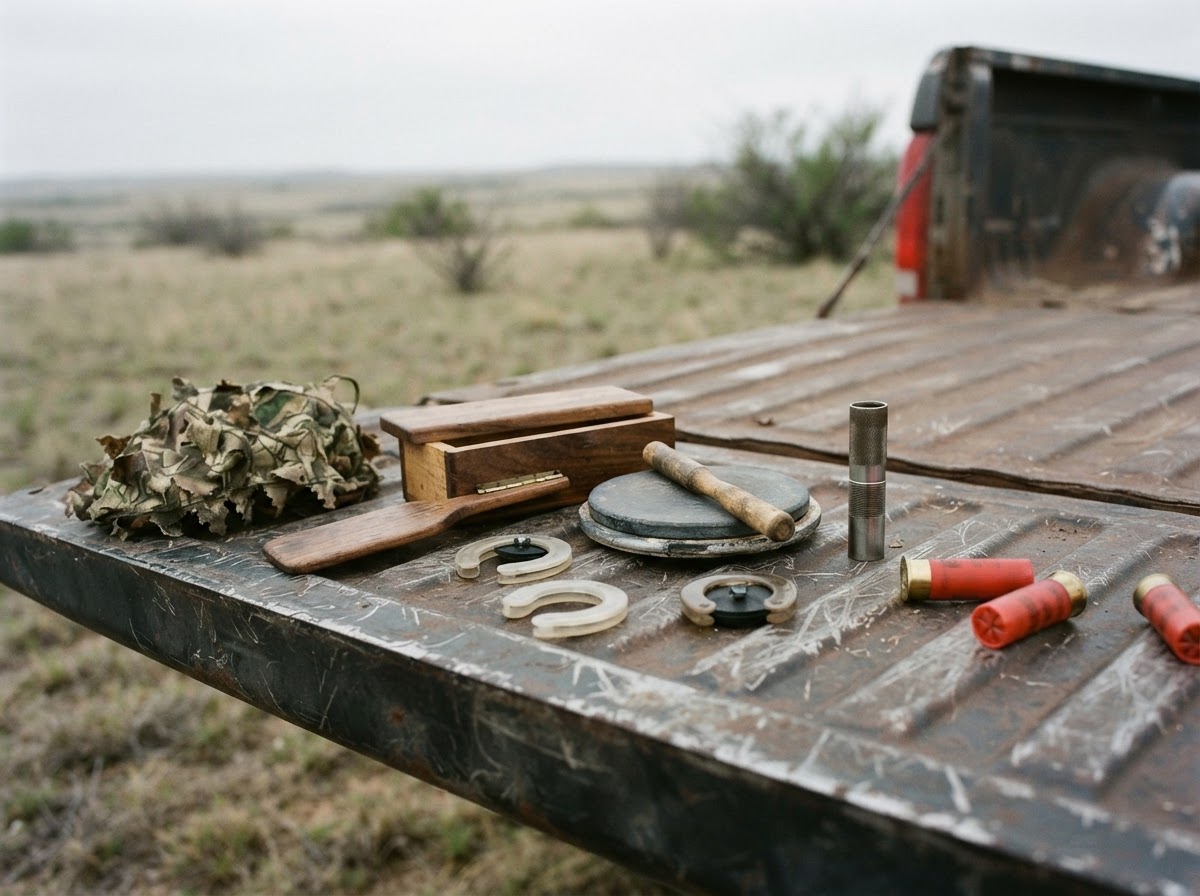
Picking the best turkey calls for Rio Grande country is a different problem than picking them for the timber, and the reason is wind. In hardwoods a soft slate call reaches every bird that matters. Out here a gobbler can be eight hundred yards off across short grass and mesquite with a twenty-mile-an-hour south wind tearing the sound apart before it ever gets to him. Volume is not a preference on the High Plains. It is the first requirement, and it is why most turkey hunters out here carry three calls that do three different jobs.
The Best Turkey Calls for Open Country, by Type
Three categories cover everything, and you want one of each rather than three of your favorite.
A box call is the loudest thing you can carry. Nothing else reaches as far across open ground, which makes it the locating tool in this country — two or three loud yelps to find a bird, then put it away. Lynch and Primos both make the long-paddle boxes that have been doing this job for decades. The tradeoffs are real: it takes both hands, the motion is visible, and a wet paddle is a dead call until it dries.
A pot call is the one you will actually hunt with. Slate, glass, aluminum or crystal over a wood or composite pot, run with a striker. It covers more range than any other call — soft clucks and purrs up to yelps that carry two hundred yards. Glass and aluminum surfaces run louder and cut wind better; slate is softer and reads as more natural up close. Woodhaven and Primos both make good ones. Carry two strikers, because a damp striker tip on a damp surface produces nothing but a squeak.
A diaphragm is the one that kills birds. Once a gobbler is inside eighty yards and looking, any hand movement ends the hunt, and a mouth call is the only option that leaves your hands on the gun. It is also the hardest to learn, which is why most people skip it and then wonder why birds hang up at sixty yards. Zink and Woodhaven both sell multi-packs with different reed cuts; buy a variety pack and find out which cut your mouth runs best rather than guessing.
Learn the diaphragm in the truck between now and spring. Nobody learns one in the field.
Wind Is the Problem Here
The Panhandle averages some of the highest sustained wind in the country, and a fifteen-to-twenty-mile-an-hour afternoon is an ordinary day rather than a bad one. That changes calling in two ways people underestimate.
First, your call does not carry as far as you think, so you have to cover ground. Calling from one spot for an hour in open country on a windy morning is mostly calling to yourself. Move, call loud, listen, move again.
Second, and this is the part that costs birds: you will not hear him answer. A gobble into a headwind at three hundred yards is gone. Plenty of hunters call, hear nothing, and walk away from a bird that gobbled twice. On windy days give it longer than feels reasonable before you move, and if the country lets you, set up with the wind at your back so your calling goes out and his gobble comes back.
Terrain helps where you can use it. Calling from the lee side of a rise, out of a draw, or from inside a creek bottom cuts the wind at your end. The canyon breaks along the Caprock are worth more on a windy morning than any call in the vest.
Locator Calls and the Roost
A locator call is not a turkey call — it is a noise that makes a gobbler give his position away without him thinking a hen is nearby.
An owl hooter in the gray before dawn will pull a shock gobble off the roost, and in this country the roosts are findable: big cottonwoods along the Canadian River, creek bottoms, and the scattered tree lines around old homesteads and windmills. Rio Grandes roost in groups and tend to use the same trees, so a bird located one morning is often a bird located all week. A crow call does the same job through the middle of the day.
The discipline is to locate and then shut up. Hooting a roosted bird and then yelping at him on the limb is how a gobbler lands two hundred yards the wrong way with his hens and never comes back.
Fall Calling Is a Different Game Than Spring
Nearly everything written about turkey calling is about spring, when a gobbler is looking for hens and a hen yelp is the most interesting sound in the world to him. Fall turkeys are not doing that at all.
In the fall you are working flocks, not individual gobblers. The classic approach is to scatter a flock and then call the birds back to each other — a kee-kee run, the lost whistle-and-yelp of a young bird, for a flock of hens and poults, or coarse assembly yelps and gobbler clucks for a group of toms. A pot call and a diaphragm cover both. The box call matters less because you are not reaching across a pasture for a lone bird.
Fall turkey in the North Zone runs November 7 through January 3, though many High Plains counties have no fall season at all — TPWD’s turkey regulations are the place to check your specific county, and the same section is where to confirm what is legal before you buy any call or decoy, since rules on things like electronic callers and live decoys are set there rather than by what a catalog sells. Spring in the North Zone opens April 3 and closes May 16, 2027, and the rest of it is in the Panhandle season dates post.
Decoys in Open Country
Open country is the one place decoys genuinely earn their weight, and the reason is simple: a gobbler can see them from four hundred yards. In thick timber a decoy is invisible until a bird is already committed. On a Panhandle pasture it is the thing that pulls him the last three hundred yards and holds him there while you get the gun up.
For spring, the setup that has worked out here for years is a submissive hen with a jake standing over her. A dominant gobbler reads that as a younger bird with his hen and comes in hot. Two hens alone work but produce a slower, more cautious approach. Avian-X and Dave Smith Decoys are the two names people land on once they have bought cheap ones and thrown them away; Montana Decoy makes collapsible ones worth considering if you are walking miles rather than hunting off a two-track.
Set them fifteen to twenty yards out and slightly to your off-shooting side, so an incoming bird’s attention is away from your gun as he closes. Facing the decoys toward you tends to bring him in facing you, which is backwards.
In the fall, leave them in the truck. Flock birds are not coming to a lone hen pretending to be something, and the weight is better spent on water.
The Other End of the Gun
Calling and decoying are what get a bird close, but open country shots stretch longer than timber shots and a factory modified choke does not hold a pattern at forty-plus yards. A dedicated turkey choke tightens the pattern enough to matter at the distances this country actually produces.
A Carlson’s Long Beard turkey choke is the common answer. Chokes are sold by thread fitment, not by gauge alone — the same model is made for Remington, Benelli, Beretta and several other thread patterns, so match the fitment to your specific gun and barrel before ordering, and check it against the markings on the factory tube that came out.
Then pattern it on paper at forty yards with the load you intend to hunt. Turkey loads and chokes are a matched pair and the combination that patterns beautifully in one gun throws a ragged pattern out of another. Finding that out in November beats finding it out in April.
What to Carry
A box call for reaching out, a pot call with two strikers for working a bird, a couple of diaphragms for the last eighty yards, an owl hooter for the roost, and in spring a jake-and-hen decoy pair. That is a vest, and it covers this country.
Twenty-seven years of guiding hunters through the Panhandle produced one consistent observation about calling: the hunters who killed birds were not the best callers. They were the ones who called less, moved more, and shut up once a gobbler was coming. The gear above is worth owning. Knowing when to stop using it is worth more.
The hunting side of it is in the complete guide to Rio Grande turkey hunting, the species background is on the turkey hunting guide, there is a how to cook a wild turkey write-up for after the fact, and the rest of the kit is on the Recommended Gear page.
Leave a Reply